
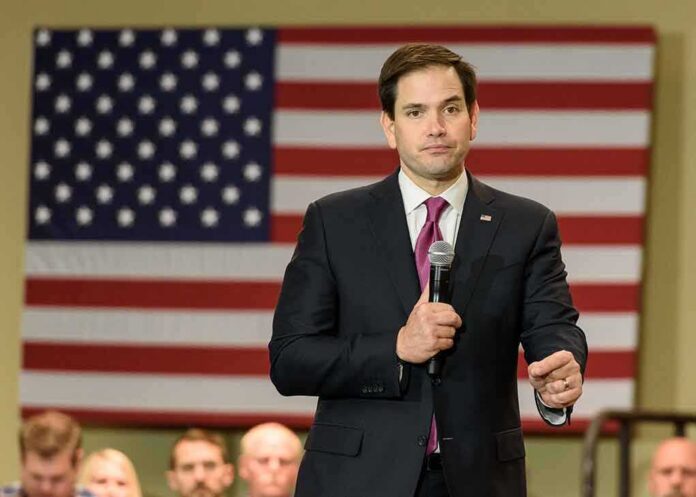
In a high-profile ministerial speech, Secretary of State Marco Rubio called communism a “distinctive and unique evil” that drains human courage, creativity, and faith, igniting a fresh fight over America’s moral and political direction.
Story Highlights
- Rubio framed communism as a godless ideology that flattens human ambition and culture.
- He argued communism requires centralized power and the end of private property.
- Critics said his rhetoric “sanewashes” allied abuses and fuels civilizational panic.
- Academic studies challenge claims that communist belief erases empathy or prosocial behavior.
Rubio’s Core Claim: Communism As A Moral And Civilizational Threat
At a ministerial focused on political terrorism on July 16, 2026, Marco Rubio said communism is driven by hatred for civilization and seeks a world “without God,” heroes, or ambition. He described it as small, grey, and stripped of nobility. He rejected the idea that communism “sounds good in theory,” calling it a unique evil. These lines anchored his case that communism harms the human spirit as well as free societies.
Rubio’s speech also linked the ideology to economic stagnation. He said communism aims to freeze economies and level people to a bare-minimum life set by the state. He tied this vision to the end of private property and the crushing of the individual. Supporters see this as a warning that fits a long line of American leaders who viewed communism as hostile to liberty and faith. Detractors said the address offered sweeping claims without new evidence.
Contested Assertions: Centralization, Property, And Propaganda Claims
Rubio argued that socialism and communism depend on centralized control, abolition of private property, and the destruction of the individual. He presented these as inherent features, not policy choices. He also blamed Cuba for spreading propaganda inside the United States and inspiring leftist groups labeled as violent by critics. Reporting of his remarks did not cite named links, documents, or cases to prove the Cuba-to-Antifa pipeline, leaving that charge disputed on evidentiary grounds.
The speech arrived in a fraught political climate. Republicans control Congress, and the White House has leaned into an America First frame. Many conservatives see communism as a threat tied to rising global left movements. Many liberals fear this rhetoric glosses over human rights problems among United States partners. Both sides, however, share anger at elites and a sense that Washington power centers ignore ordinary people’s struggles with costs, safety, and dignity. Rubio’s framing tapped that shared mood.
Pushback From Human-Rights Voices And Academic Research
Human-rights advocates argued Rubio’s tone “sanewashed” abuses by some United States-aligned regimes by painting a stark civilizational battle that sidelines victims on both sides. A Harvard center commentary said the speech promoted “civilizational panic” rather than specific, testable claims. These critics warned that moral absolutes can blur lines between policies, people, and regimes, and can excuse bad acts by allies if they are labeled anti-communist.
WATCH: Marco Rubio lays out a sweeping rebuke of communism, calling it a system that strips away everything that makes people aspire to greatness:
"Communism does not sound good in theory… The world it envisions for all of us is small, flat, gray… without courage, creativity… pic.twitter.com/OKWlLmu0Nj
— Kusi Yeboah Kwame Isaac (@IsaacKwameKusiY) July 16, 2026
Several studies complicate the claim that communism erases human virtue. One peer-reviewed paper found belief in communism correlated with stronger Theory of Mind, which is tied to empathy and social understanding. Another study in psychology reported reminders of communist authority increased prosocial behavior among students, moderated by empathy levels. These findings do not settle the debate on regimes or economics, but they undercut blanket claims about lost courage or empathy under communist belief.
Why This Matters For Americans Tired Of Empty Promises
Rubio’s speech landed because millions feel the system is rigged, whether by far-left ideologues, corporate cartels, or a permanent government. His warning about concentrated power speaks to fears of control by elites, public or private. Yet the charge that Cuba inspired Antifa still lacks documented proof in the material cited. When strong claims skip verifiable details, trust falls further, and the public gets more cynical about both parties’ narratives.
For readers across the spectrum, two tests can keep this debate honest. First, demand documents and data for any claim about foreign influence or terrorism links. Second, measure systems by real outcomes: innovation, freedom of worship, rule of law, economic mobility, and dignity at work. If an ideology or a coalition fails those tests, call it out. If a claim cannot be sourced, press pause. That is how a free people checks both utopian promises and fear-driven politics.
What To Watch Next: Evidence, Not Slogans
Expect follow-up scrutiny of the ministerial remarks. Freedom of Information Act requests for records on alleged Cuban operations could clarify or undercut the Antifa claim. Human-rights groups will continue to test anti-communist rhetoric against partner conduct. Researchers may add data on property rights and innovation, or on how belief systems shape empathy and cooperation. Voters should track the receipts, not the heat, and press leaders to fix real problems at home with proof-based policy.
Sources:
facebook.com, wnd.com, townhall.com, instagram.com, commondreams.org, youtube.com, econstor.eu