America just launched direct strikes on Iran’s Revolutionary Guard after U.S. troops were killed in Jordan, pulling a long-shadow war into the open and raising fresh questions about who really calls the shots—and who pays the price.
Story Snapshot
- U.S. forces hit more than 85 targets tied to Iran’s Revolutionary Guard and allied militias after a deadly drone attack on a base in Jordan.
- Washington blames Iran’s Islamic Revolutionary Guard Corps and an Iran-backed militia network for the strike that killed American troops, while Iran denies direct involvement.
- The United States describes the strikes as “punishing” and defensive, but reports of civilian deaths and damaged infrastructure fuel anger across the region.
- Years of tit-for-tat attacks between the U.S. and Iran show a pattern of shadow wars run by powerful elites, far from the everyday Americans and Middle Eastern civilians caught in the middle.
What Triggered the U.S. Strikes on Iran’s Revolutionary Guard
U.S. Central Command said American forces launched airstrikes after a drone attack on a U.S. base in Jordan killed service members and wounded others. The base, often called Tower 22, sits near Jordan’s border with Syria and helps support U.S. operations in the region. President Joe Biden earlier framed the January 2024 attack as carried out by militant groups backed by Iran’s Islamic Revolutionary Guard Corps. That set the stage for later decisions to go after the Guard directly, not just its proxy militias.
Initial U.S. statements focused on the “Islamic Resistance in Iraq,” an umbrella group of Iran-backed militias blamed for the drone strike. National Security Council spokesman John Kirby said intelligence pointed to this network, which includes factions like Kataib Hezbollah that receive weapons and training from Iran. At the same time, White House and Pentagon officials stressed they were still reviewing evidence, which left some uncertainty over how much direct command Iran itself exercised over the attack.
How and Where the U.S. Struck Back
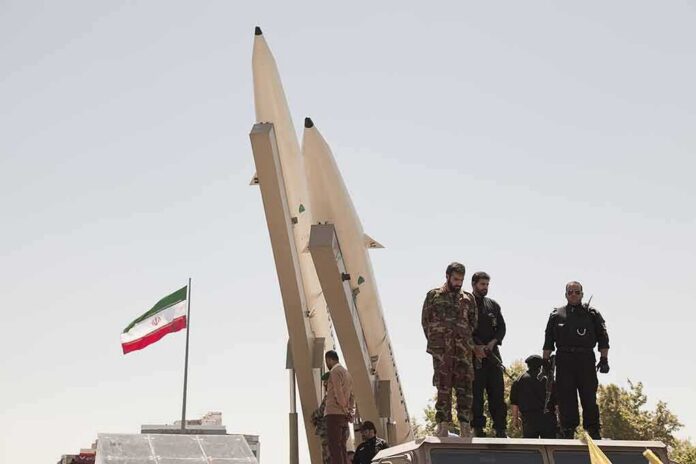
U.S. Central Command reported that American forces hit more than 85 targets across seven facilities in Iraq and Syria linked to Iran’s Revolutionary Guard Quds Force and allied militias. The strikes used about 125 precision weapons over roughly 30 minutes, including long-range bombers flown from the United States. Targets included command centers, intelligence hubs, rockets, missiles, drone storage sites, and logistics and ammunition facilities that the U.S. says were used to attack American and coalition troops.
In later rounds of fighting, the U.S. expanded its strikes directly inside Iran, going after Revolutionary Guard coastal surveillance and air defense sites, maritime assets, and missile and drone storage locations. U.S. officials described these attacks as “self-defense strikes” meant to punish Iran and reduce its ability to threaten U.S. forces and shipping lanes. The campaign has stretched over multiple nights of bombing, with Central Command saying units behind attacks on U.S. troops in Jordan were among those struck.
Iran’s Denial and the Battle Over Blame
Iran’s government has strongly denied ordering the original drone strike that killed the U.S. troops in Jordan, saying it had “no association” with the incident and blaming local resistance groups instead. Iranian officials cast the U.S. response as “blatant aggression” and a violation of their national sovereignty, especially once strikes moved inside Iran’s borders. At the same time, an Iran-backed umbrella group, the Islamic Resistance in Iraq, publicly claimed responsibility for the attack, which complicates Tehran’s efforts to distance itself.
U.S. officials argue that even if militias carried out the attack, Iran’s Revolutionary Guard equips and guides many of these groups and therefore bears responsibility. Kirby said the strike had the “earmarks” of Kataib Hezbollah and similar militias closely tied to the Guard. However, Washington has not released detailed intelligence, such as intercepted orders or forensic data from the drone, for public review. That lack of transparent proof fuels doubts among both skeptics at home and governments abroad who already worry that elites use classified claims to justify wars regular people never asked for.
Civilian Harm, Economic Shock, and a Pattern of Endless Retaliation
While U.S. officials say targets were “carefully selected” to limit civilian harm, reporting from the region suggests the picture is more complicated. Local sources in Iraq and Syria have described casualties among fighters from Iran-backed groups, but also deaths and injuries among civilians near the strike sites. In separate Iran-related strikes covered by international media, hits on bridges, energy facilities, and coastal infrastructure raised questions about whether the line between military and civilian objects is really being respected.
❗️ U.S. EXPANDS IRAN STRIKES AS TEHRAN TARGETS GULF BASES AND ISRAEL THWARTS ASSASSINATION PLOT
💥 U.S. forces launched a major new campaign against Islamic Revolutionary Guard Corps targets across Iran after Iranian missile strikes killed two American soldiers in Jordan. More… pic.twitter.com/TPNWyfwAG8
— Israel Realtime (@IsraelRealtime) July 19, 2026
These latest strikes fit into a broader cycle where Iran-backed militias have carried out more than 170 attacks on U.S. bases in Syria, Iraq, and Jordan since late 2023, and the U.S. has answered with repeated bombing runs. Each side claims it is acting in self-defense. Each side says it wants to avoid a wider war. Yet the pattern keeps escalating, drawing in shipping routes, oil prices, and neighboring countries. For many Americans and Middle Eastern civilians, it looks like the same story they have seen for decades: powerful governments and security services trade blows, while ordinary people face higher prices, more danger, and less trust that anyone in charge is truly working for them, not for the entrenched elites and “deep state” networks that never seem to pay the cost.
Sources:
abcnews.com, bbc.com, dw.com, aljazeera.com, youtube.com, apnews.com, timesofisrael.com, thehill.com, justice.gov