A fight over Donald Trump’s SAVE America Act is exposing how both parties spin voting rules while millions of everyday citizens worry their voices will be buried under paperwork and politics.
Story Snapshot
- The SAVE America Act requires documentary proof of U.S. citizenship to register and photo ID to vote in federal elections.
- Voting-rights groups say the bill could burden up to 69 million married women whose documents show different last names.
- Republican leaders and the White House insist married women “will still be able to vote” and call fears a “myth.”
- Both sides agree non‑citizen voting is rare, raising questions about whether new rules mainly add red tape for honest voters.
What the SAVE America Act Actually Requires
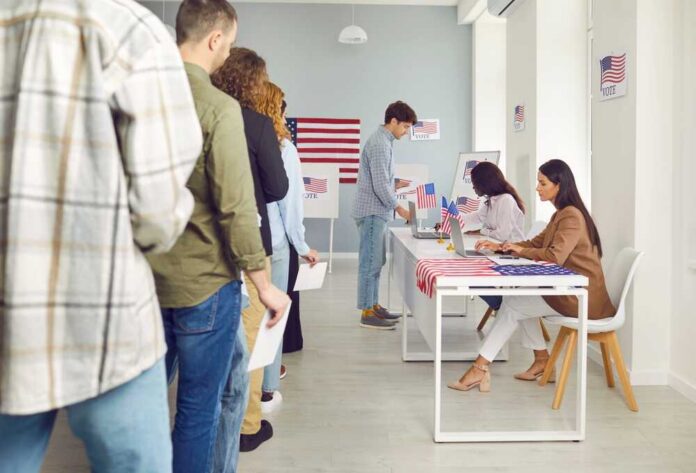
The Safeguard American Voter Eligibility (SAVE America) Act would reshape how Americans register and vote in federal elections. The bill requires people to show documentary proof of United States citizenship when they sign up to vote, like a United States passport, a qualifying Real ID, or a birth or naturalization certificate with a matching name. It also adds a second hurdle: voters must show a government‑issued photo ID when they cast a ballot in person, and include copies of ID when voting by mail. Supporters say these steps protect elections from non‑citizens; critics see extra hoops for citizens who already play by the rules.
Under the bill, registration can no longer rely only on simple forms sent by mail or completed online. States would be barred from processing federal voter registrations unless officials verify citizenship documents in person, or through a state‑designed process that still demands paperwork and an attestation under penalty of perjury. Every time a voter moves, changes their name, or updates their registration, they would need to repeat this proof of citizenship step. For busy workers, caregivers, people with disabilities, and those far from government offices, these new in‑person rules could mean taking off work, arranging travel, or finding child care just to stay on the rolls.
Why Married Women and Name Changes Are a Flashpoint
One of the biggest worries centers on name changes, especially for married women who took their spouse’s last name. Many women have a birth certificate, passport, or other citizenship document in their original name, but a driver’s license or current ID with a different last name. The SAVE America Act says citizenship papers with a name that does not match current identification cannot be used alone. Democracy Docket and other advocates estimate that as many as 69 million women fall into this group and could need extra records like marriage certificates, divorce decrees, or court orders to prove who they are.
Critics argue this added paperwork turns a simple right into a document hunt that hits women, low‑income voters, and transgender Americans hardest. They point out that many people do not keep certified copies of every marriage or divorce record, or may struggle to get them from distant courts or agencies that charge fees. The bill leaves it to each state to design its own process for handling “discrepancies” between documents, including deciding what extra proof is “necessary” and how often it must be shown. That flexibility may sound helpful, but it also means 50 different rulebooks and more chances for confusion, delay, or error when citizens simply try to register.
Republicans Call Fears a ‘Myth,’ Advocates Say Barriers Are Real
Republican sponsors and the Trump White House strongly reject claims that the SAVE America Act blocks married women from voting. Representative Barry Loudermilk’s “Myth vs. Fact” sheet says the bill “does not prevent women who get married and change their name from voting” and stresses that states must set up a process to handle document mismatches. Representative Stephanie Bice has echoed that point, telling supporters that women who changed their names “will still be able to vote” if they follow state procedures. White House Press Secretary Karoline Leavitt calls Democratic warnings “fearmongering,” insisting that women already registered are unaffected and new voters can use birth, marriage, or divorce certificates to clear up name changes.
Voting‑rights groups do not claim the law writes a direct ban on married women voting; they focus on how much harder it could become in practice. The National Women’s Law Center estimates more than 21 million eligible voters may lack the required citizenship documents ready to go, with married women and transgender people most at risk of being pushed out. Disability advocates warn that added trips, signatures, and ID copies will further shut out citizens who already struggle to navigate polling places and registration offices. League of Women Voters chapters and bipartisan policy analysts stress that the law stacks multiple requirements—citizenship proof, narrow photo ID rules, and mail voting paperwork—on top of each other, raising the odds that honest voters slip through the cracks.
Security Concerns, Rare Fraud, and Growing Public Distrust
The SAVE America Act is sold as a way to stop non‑citizens from voting, yet even friendly fact‑checks show such cases are extremely rare. A database reviewed on CNN found fewer than 100 confirmed examples of non‑citizens casting ballots between 2000 and 2025, out of billions of votes. The Congressional Research Service notes that existing federal law already bars non‑citizens from registering and makes it a crime to lie about citizenship on voter forms. This leaves many Americans asking whether new layers of paperwork target a huge problem or mainly feed political talking points before midterm elections.
EX POST!™ JULY 13, 2026
FACT CHECK🚨 DESPERATE REPUBLICANS ARE PASSING AROUND DEEPFAKES
Republican accounts are circulating a video that appears to put false words into Sen. Elissa Slotkin’s mouth.
The clip promoted by @libsoftiktok uses real-looking footage of Slotkin… pic.twitter.com/pJcgOqhS6g
— EX POST! (@ExPostMedia) July 14, 2026
For conservatives who feel past leaders ignored voter integrity, the bill looks like long‑promised action. For liberals who see voting as a basic shield for the powerless, it looks like another wall built between ordinary people and the ballot box. Both sides share a deeper worry: a federal system that seems better at policing citizens than serving them. The fight over married women and name changes under the SAVE America Act is not just about documents. It is about whether those in power are writing election rules to protect democracy, or to control who gets heard.
Sources:
youtube.com, newsweek.com, 19thnews.org, katv.com, democracydocket.com, loudermilk.house.gov, nwlc.org, lwvil.org, bipartisanpolicy.org, abc3340.com