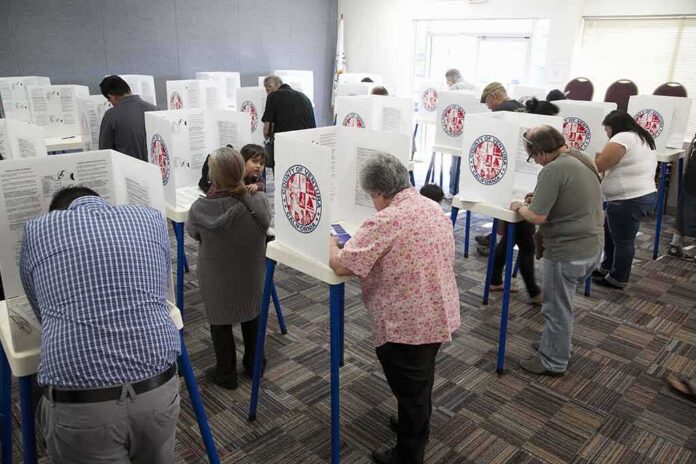
Federal prosecutors say a Colombian national lived under a stolen identity for over 20 years and even cast a ballot in the 2024 presidential election before a judge sent her to prison.
Story Snapshot
- Justice Department says the defendant used a stolen identity to register and vote in 2024.
- Court records describe decades of fraud tied to benefits and identification documents.
- Case highlights rare but real instances of noncitizen voting, often linked to identity theft.
- Federal law imposes criminal penalties for false citizenship claims and illegal voting.
What The Court Said Happened
The U.S. Attorney’s Office in Massachusetts said the woman, a Colombian national without lawful status, used another American’s name, date of birth, and Social Security number for more than two decades. Prosecutors said she registered to vote and used the stolen identity to cast a ballot in Boston in the November 2024 presidential election. The court sentenced her to prison and described how the same false identity supported other frauds, including a state identification card and federal benefits.
Prosecutors said the defendant obtained a Massachusetts REAL ID and drew more than four hundred thousand dollars in federal benefits under the stolen identity. The Department of Justice linked the voting offense to a larger pattern of identity misuse, which made the case easier to prove and charge. Court filings emphasized that the voting was not an isolated act but part of a long-running scheme that touched multiple systems that rely on accurate identity data.
How Federal Law Treats These Offenses
Federal statutes make it a crime to falsely claim United States citizenship, including on forms tied to voting and benefits. Separate federal laws cover identity theft and document fraud, which often accompany ineligible voting cases. Policy analysts note that prosecutions in this area commonly center on the identity crimes that enable the ballot to be cast, not just the act of voting while ineligible. That mix increases penalties and signals that identity violations trigger wide legal risks.
Researchers and election officials report that noncitizen voting is rare when compared to the total number of ballots cast nationwide. A review by a nonpartisan research group found only a very small number of documented noncitizen voting cases over two decades, based on court records and official investigations. Still, the cases that do arise tend to be clear-cut because they involve forged or stolen identities, which generate paper trails, agency alerts, and financial records that investigators can verify.
Why This Case Resonates Across The Aisle
For many Americans, this case confirms fears that weak identity checks can let one person pose as another for years. Voters on the right see a threat to election integrity. Voters on the left see how identity theft harms real citizens and drains public aid. Both sides can agree that systems should block stolen identities from unlocking ballots, benefits, and official identification. The sentence shows that courts can act when evidence is strong and the fraud is documented.
The Justice Department has also defended state efforts to secure voter rolls with proof-of-citizenship rules in court filings, even while other federal actions target flawed purge programs elsewhere. That split posture reflects a basic balance: protect eligible voters while stopping ineligible voting. This case will likely feed debates in Congress and in statehouses about how to verify citizenship and identity without blocking lawful voters, especially naturalized citizens, from the ballot.
Sources:
thegatewaypundit.com, foxnews.com, caselaw.findlaw.com, justice.gov, ce9.uscourts.gov