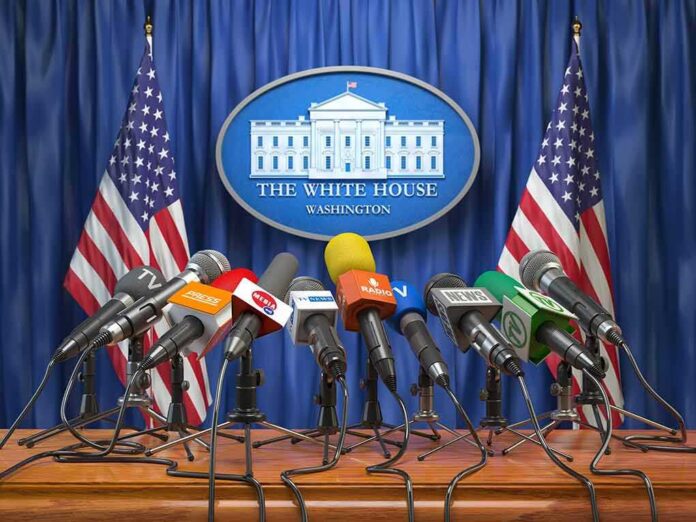
President Trump is weighing a plan to move the White House press corps out of the West Wing, a shift that could redefine how the public gets its news from the presidency.
Story Snapshot
- Trump has discussed relocating reporters and repurposing the James S. Brady Briefing Room, including restoring an indoor pool.
- The White House Correspondents’ Association warned the move could threaten press independence and public access.
- Advisers reportedly cautioned that a move to the Eisenhower Executive Office Building could be a logistical mess and spark backlash.
- Past relocations show proximity matters; moves off-site have reduced access and speed of reporting.
What the White House Is Considering Now
Reports say President Trump has pressed aides to remove reporters from the James S. Brady Press Briefing Room and even restore an indoor swimming pool beneath it. The New York Times reported that he directed staff to pursue the move, which would shift journalists out of the West Wing footprint. The idea follows earlier steps that narrowed media access to certain West Wing spaces, while keeping formal briefings in place elsewhere on the campus, including the option of the Eisenhower Executive Office Building across the street.
White House officials have not denied the pool concept. A senior communications aide said “all options remain on the table,” which leaves the door open to a change in both the space and the press’s daily routine. Supporters argue that moving the press does not have to mean less access if the administration maintains scheduled briefings and allows reporters to work from another on-campus facility. They point to past periods when renovations forced temporary shifts without ending coverage.
Why Proximity to Power Matters
The White House Correspondents’ Association responded that removing the press from the West Wing would cut at the independence of a free press and risks letting the government pick who covers the president. The group said it was not consulted on earlier access decisions and vowed to press for full transparency. History backs their concern: when press events moved outside the West Wing in earlier eras, reporters lost immediate access to phones and support systems that speed coverage and quick questions to staff.
Past changes show the trade-offs. During the George W. Bush years, a major remodel sent reporters across Pennsylvania Avenue to the White House Conference Center. Briefings continued, but the distance reduced informal contacts that often break news and allow fast follow-ups. For readers, that proximity is not symbolism. It shapes how quickly reporters can confirm facts, press for clarity, and share what they learn. When access is slower, the public waits longer to get answers.
Logistics, Politics, and the Public Interest
Advisers have reportedly warned that shifting the entire press corps to the Eisenhower Executive Office Building would be difficult to run and politically risky. They cautioned it could invite a backlash that distracts from policy goals and feeds a larger fight over openness. Some advisers also feared coverage could worsen if the move deepens friction with reporters, leaving the White House less able to get its message out on tight timelines. These concerns reflect hard lessons from earlier access battles.
Supporters of a move say a larger or better-equipped space could help more outlets attend briefings and work more comfortably. They note that the Brady Room has only 49 assigned seats while the accredited press corps is much larger. They argue modern tools allow fast transmission from anywhere on the complex. Still, history suggests that even a short walk can limit chance encounters with staff and reduce the quick back-and-forth that often reveals facts the public needs.
What This Means for Trust and Accountability
This proposal lands in a time when many Americans feel shut out by their own government. People on the right see a media class they do not trust. People on the left see an administration they fear will narrow scrutiny. Both groups share a core demand: tell the truth, fast, and with proof. Any plan that moves reporters out of the West Wing must meet that test with clear rules that keep access equal, frequent, and on time, not just in name.
President Trump has discussed the possibility of moving the White House press corps to another building, according to two people close to the president. https://t.co/YGHkTAELdU
— CBS News (@CBSNews) October 21, 2026
The path forward is simple to state and hard to do. If the White House wants a new space, it should publish a plan that protects daily proximity, guarantees open briefings, and bars political picking of who gets in the room. The press should publish matching standards for fair coverage and fast corrections. That deal would serve the public first. Without it, the move will look like one more step by the powerful to control the story, rather than to serve the people.
Sources:
tvinsider.com, politico.com, wionews.com, whca.press, mediaconfidential.blogspot.com, yahoo.com