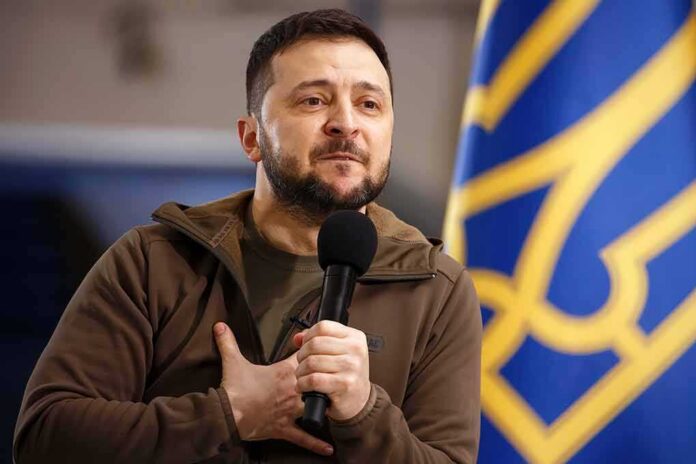
President Volodymyr Zelensky says holding elections during Ukraine’s war with Russia could tear the country apart, calling a wartime vote “a tsunami” that would “destroy” national unity.
Story Snapshot
- Zelensky rejected wartime elections on August 23, 2026, warning they would split Ukraine.
- Ukrainian law bans elections while martial law is in effect, a rule election officials have repeated for years.
- Millions of displaced voters and 1,200 kilometers of active front line make voting logistics extremely hard.
- Ousted defense minister Mykhailo Fedorov is pushing back, calling for a “legal, safe, and realistic” wartime vote.
- Critics say the no-election stance could look self-serving even though the legal case is strong.
Zelensky Calls Wartime Vote A Threat To Unity
Zelensky told reporters on August 23 that elections during active fighting would be “a huge risk.” He said, “Elections right now are a tsunami for the country that will split Ukraine.” He argued a wartime vote could tear the nation apart rather than strengthen it, a warning that landed hard given Ukraine’s ongoing fight for survival against Russia.
Zelensky did leave one door open. He said a wartime election might work if Ukraine’s allies guaranteed security for voters and polling places. But he added a blunt caveat: “No one has proposed such a plan”. That leaves the idea stuck for now, with no concrete plan on the table from any foreign partner.
The Law Already Bans Wartime Voting
Ukrainian law is clear on this point. Martial law bans elections for security reasons, and Zelensky’s team says the rule leaves little room for debate. Back in 2023, national security official Oleksiy Danilov said flatly, “No elections in Ukraine, neither parliamentary nor presidential, can be held during martial law”. Ukraine’s parliament reaffirmed that rule again in early 2025, saying voting must wait for lasting peace.
Election commission chief Oleg Didenko has echoed the same warning. He told a reporter that officials “can’t guarantee either the safety of voters or an electoral process that meets democratic standards” while martial law stays in place. That combination of legal bar and safety risk forms the backbone of Kyiv’s case against holding a vote right now.
The numbers behind that argument are staggering. About 6 million Ukrainians live abroad as refugees. Another 3.7 million are displaced inside the country. Roughly 3.5 million live under Russian occupation. The active front line stretches about 1,200 kilometers, making safe, fair voting nearly impossible to organize under current conditions.
A Rival Says Democracy Shouldn’t Wait
Not everyone agrees with Zelensky’s timeline. Mykhailo Fedorov, Ukraine’s recently ousted defense minister, posted a video call for change. “Democracy cannot be held hostage by Russia,” he said, pushing for a “legal, safe, and realistic mechanism” that would let Ukraine hold elections even during a long war. His challenge marks the sharpest internal pushback against Zelensky’s wartime leadership since Russia’s 2022 invasion.
Fedorov wants any wartime vote to protect the rights of soldiers, Ukrainians living overseas, and people near the front lines. Supporters of his push argue that political trust erodes when voters can’t renew or reject their government’s mandate for years on end, warning that an “exceptional” wartime extension risks becoming Ukraine’s new normal.
Why This Fight Matters Beyond Ukraine
Legal experts outside Ukraine largely back Zelensky’s position, noting the country’s constitution specifically forbids elections while martial law remains active, a rule unchanged since the war began in February 2022. Still, this debate isn’t just a legal technicality. It’s a test of whether a government can suspend democratic norms during an emergency without those norms becoming permanently postponed.
Ukrainian President Volodymyr Zelensky has rejected calls for wartime elections, saying the move would 'destroy the country.'
Read more: https://t.co/KWow79fqqc#WorldNews #VolodymyrZelensky #RussiaUkraine
— UPI.com (@UPI) August 24, 2026
The dispute lands in an environment already shaped by corruption probes and public frustration with Ukraine’s wartime governing system. Even Zelensky’s supporters admit that scrutiny complicates the picture. When a leader in power argues against a vote that could remove him from office, that argument invites suspicion, whether or not the underlying legal reasoning holds up on paper.
Sources:
time.com, aljazeera.com, reuters.com, cnbc.com, anews.com.tr, english.nv.ua, bloomberg.com