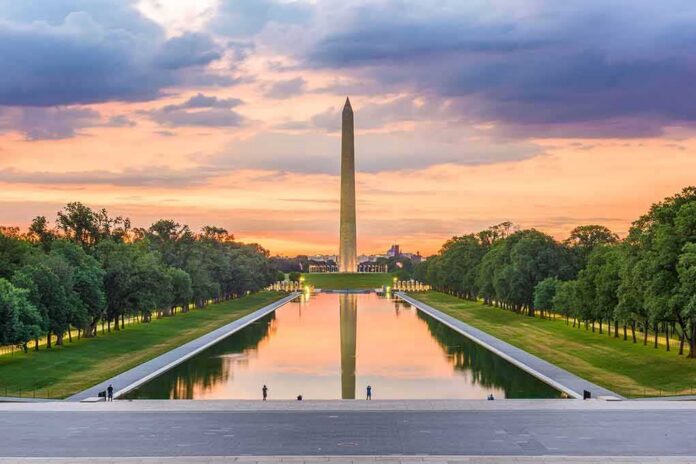
The Lincoln Memorial Reflecting Pool saga is a case study in how quickly a simple, politically convenient explanation can collapse once the paperwork catches up with the rhetoric — and how, even after the government’s own lawyers admit the paperwork won this round, the simple explanation refuses to die.
Key Points
- President Trump spent weeks in June 2026 blaming “vandals” for damage to the newly repainted Reflecting Pool, including claims of a 350-foot cut and chemical sabotage.
- Former Olympic canoeist David Hearn was charged with felony vandalism, then had the case dismissed by the Justice Department itself in late July after Interior Department records surfaced.
- Prosecutors said the real cause was a rushed, botched contractor installation — repeated lining failures and peeling that began within two days of the project’s completion.
- A federal judge formally tossed the case in early August, even as the White House pressed the Justice Department to revive it.
- The episode traces back to an unusual no-bid contract awarded under wartime-style emergency provisions to a firm with no prior pool-coating experience.
A $14 Million Renovation Meets a 250th-Anniversary Deadline
The Reflecting Pool project began as a modest cosmetic fix — resurfacing and repainting the National Mall’s signature basin ahead of America’s 250th-anniversary celebrations — with an initial estimate near $1.8 million. It ballooned to roughly $14 million, and by some contract reviews, north of $16 million, as the timeline compressed and the scope expanded. Interior Department staff flagged quality problems early: bubbling, pinholes, and uneven coating in the waterproofing layer, defects consistent with work applied too fast and under too little surface preparation. The contract itself was awarded without competitive bidding, using emergency provisions typically reserved for wartime or disaster response, to a company whose core business was culvert, pipe, and fuel-tank repair rather than large-scale pool coatings — a detail Trump himself later disavowed after having referenced a “pool guy” who could do the job cheaply and fast.
That mismatch between urgency and expertise set the stage for what followed. Within days of the pool’s reopening, the new blue coating began peeling, and algae bloomed rapidly across roughly thirty acres of shallow, stagnant water — conditions pond-management experts note are practically engineered to grow algae once a protective seal fails. The administration’s public response to visible deterioration was not to audit the installation; it was to describe the damage as an attack.
The Vandalism Narrative Takes Hold
Trump first floated the vandalism explanation in mid-June 2026, telling reporters flatly, “It’s vandalism,” and later describing a gash roughly 350 feet long along with chemical sabotage. The Department of the Interior followed with arrests and citations, and U.S. Attorney Jeanine Pirro’s office indicted David Hearn, a three-time Olympic canoeist, on a felony vandalism charge, alleging he had forcefully torn at the pool’s liner with his bare hands. Hearn’s account was starkly different: he told reporters he had been biking past, noticed a loose flap of coating in the water, and touched it out of curiosity — an account that became the through-line of his defense from the outset.
The claim was not built on nothing. A National Park Service official filed a sworn statement describing what investigators characterized as intentional damage — caulk over foam sealant “cut with a sharp knife or razor” and destruction of delaminating surface material observed on June 9. That statement gave the administration’s narrative a genuine evidentiary anchor, even as independent reporting noted that no video or other proof had surfaced to support the far larger claim of a 350-foot deliberate gash. Trump himself eventually conceded there was “no video or proof” of the broader sabotage he had been describing for weeks, even as he continued pressing the vandalism framing in subsequent statements and social media posts.
The Reversal: A Contractor’s Failure, Not a Saboteur’s Knife
The case unraveled in late July 2026, when the Justice Department itself moved to dismiss the felony charge against Hearn. Prosecutors said Interior Department documents — received only after the indictment — showed the damage was “the result of flawed installation by the contractor,” identified as Atlantic Industrial Coatings. The filing was specific and damning toward the project itself: a “rushed and flawed installation process, with repeated failures of the lining during the installation process, and extensive peeling of the lining throughout the Reflecting Pool.” The New York Times reported that the pool’s new coating had actually begun peeling within two days of the project’s completion, well before Hearn’s alleged encounter with the liner. Reuters characterized the core finding bluntly: “A flawed installation, not vandalism, caused the liner of the newly renovated Lincoln Memorial Reflecting Pool to peel.”
Crucially, Pirro’s office acknowledged that this evidence was “not known to the prosecutors or the grand jury before the return of the indictment” — meaning the felony case had proceeded on an incomplete record, one that emphasized isolated intentional-looking damage while omitting the systemic installation failure documented elsewhere in Interior’s own files. A federal judge formally dismissed the case against Hearn on August 7, closing out a prosecution that had run from felony indictment to public collapse in under two months. Hearn’s attorney, Norm Eisen, called the episode a case of “ready, aim, fire” prosecution — charges brought and escalated to felony status before the government had done the underlying diligence.
An Unresolved Coda
The dismissal did not end the political dispute. The Guardian reported that the White House subsequently pushed the Justice Department to revive the case against Hearn even after Pirro’s own office had dropped it and blamed the contractor. That pressure sits awkwardly alongside the documentary record: a sworn statement describing what looked like intentional cutting on one section of coating, set against a much larger body of contractor and inspection records showing systemic, unrelated failure across the pool’s lining. Both things can be true in isolated respects — some localized tampering is not incompatible with a poorly executed installation — but the felony case rested on the broader vandalism narrative, and it is that broader narrative the government’s own filings undercut.
"Look what VANDALS did."
President Trump shared a new photo of the National Mall, blasting what he described as damage to the grass connecting the World War II Memorial and the Reflecting Pool.
Trump said the Reflecting Pool "will be opened again, and better than ever, shortly pic.twitter.com/5ADkrAWWTS
— Alex West (@west_alex777) August 17, 2026
What the Episode Reveals About Public-Works Accountability
The Reflecting Pool dispute is a textbook illustration of a familiar failure mode in public infrastructure controversies: the first explanation offered is almost always the simplest and most emotionally satisfying one, while the real explanation — schedule compression, inadequate surface prep, a contractor selected for speed rather than expertise — depends on technical records that surface weeks or months later, after the political narrative has already hardened in public. FactCheck.org’s contemporaneous review noted the administration had not backed its vandalism claims with evidence even as officials continued repeating them. Once Interior’s own inspection trail entered the court record, the case for sabotage gave way to a far more mundane, and far more common, story: a rushed no-bid contract, an inexperienced contractor, and a coating that started failing almost immediately. For anyone evaluating future claims about damage to public property, the lesson is durable — verify the paper trail before accepting the headline.
Sources:
facebook.com, reuters.com, theguardian.com, abcnews.com, nbcnews.com, foxnews.com, factcheck.org, theatlantic.com, cnn.com