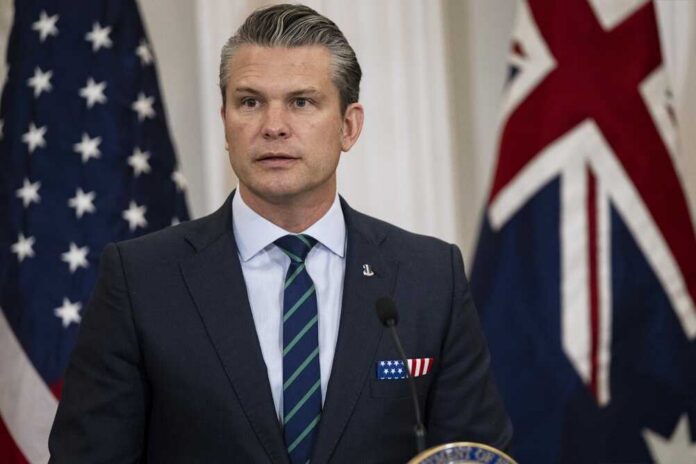
A Pentagon prayer service is now at the center of a new culture-and-command controversy after Defense Secretary Pete Hegseth recited a “Pulp Fiction”-inspired invocation that calls for “great vengeance” amid the Iran war.
Quick Take
- Pete Hegseth led a Pentagon worship service and recited “CSAR 2517,” a prayer adapted from a monologue popularized by the film Pulp Fiction, loosely tied to Ezekiel 25:17.
- The prayer was presented as connected to a recent U.S. combat search-and-rescue operation (“Sandy 1”) that recovered aircrew shot down over Iran.
- Critics argued the moment blurred faith, pop culture, and warfare; Pentagon messaging defended it as warfighter-inspired and rooted in biblical themes.
- Pope Leo XIV publicly warned against using religion to justify violence, intensifying the political and moral debate around wartime rhetoric.
What happened at the Pentagon worship service
Defense Secretary Pete Hegseth led a Pentagon worship service where he recited a prayer labeled “CSAR 2517” (Combat Search and Rescue 25:17). Reports describe the text as adapted from the well-known Samuel L. Jackson monologue in Pulp Fiction, which itself riffs on a loosely referenced Ezekiel passage. In this version, the prayer blesses a recent rescue mission and invokes “great vengeance and furious anger” against Iranian forces.
Accounts of the service tie the prayer to a rescue operation commonly referred to as “Sandy 1,” which retrieved U.S. Air Force crew members shot down over Iran. The precise date and details of the shootdown and extraction were described as “recent” relative to the service. The prayer’s framing placed the mission in a moral struggle between good and evil, with the rescue held up as proof of providence and purpose.
How “CSAR 2517” connects to Scripture—and to Hollywood
Multiple outlets reported that “CSAR 2517” echoes Ezekiel 25:17 while drawing more directly from the fictionalized version made famous by Pulp Fiction. The military-style title signals its connection to combat search-and-rescue culture, and reporting indicates the adaptation existed before this Pentagon event. Hegseth reportedly credited a “Sandy 1” mission planner with providing the text and said it reflected Ezekiel’s themes, while the film connection became the flashpoint.
That distinction matters because it separates two debates that often get mashed together in Washington: faith in public leadership versus the use of faith as a branding tool. Hegseth’s defenders point to the prayer’s military origin and to biblical language about justice and deliverance. Critics argue that borrowing a pop-culture monologue—especially one associated with pre-violence theatrics—risks turning religion into a motivational prop rather than a moral compass, particularly during an active war.
Why the backlash is about legitimacy, not just language
The sharpest criticism focused less on the prayer’s existence and more on what it implies about how power is justified. Some coverage characterized the Iran conflict as “illegal,” while other reports focused on the service as an unusual blending of worship and war rhetoric. It underscores a broader reality for Americans across the political spectrum: people are increasingly skeptical of official narratives, and they scrutinize symbols—especially religious ones—for signs of manipulation by elites.
Pope Leo XIV’s warning adds an international moral critique
Pope Leo XIV publicly condemned the manipulation of religion to support war, with reporting indicating he cited scripture to reject prayers that sanctify violence. The pope’s comments did not decide the policy questions around Iran, but they amplified the moral stakes and forced a wider discussion about where spiritual encouragement ends and political messaging begins. In the U.S., that line is especially sensitive inside government institutions that wield force.
For conservatives who value religious liberty and a strong military, the controversy lands in a complicated place. Many Americans support chaplaincy and voluntary worship, and they respect leaders who speak plainly about faith. At the same time, tying divine sanction to state violence can backfire by turning faith into a partisan weapon—fueling distrust at home and feeding propaganda abroad. The clearest takeaway is political: symbolism now drives headlines almost as much as strategy.
Sources:
Hegseth Borrows Violent Prayer from ‘Pulp Fiction’ to Bless Iran War
Hegseth recites ‘Pulp Fiction’ speech at Pentagon prayer service
Pentagon Pete Hegseth Cites Fake ‘Pulp Fiction’ Bible Verse in Bonkers Prayer Meeting