
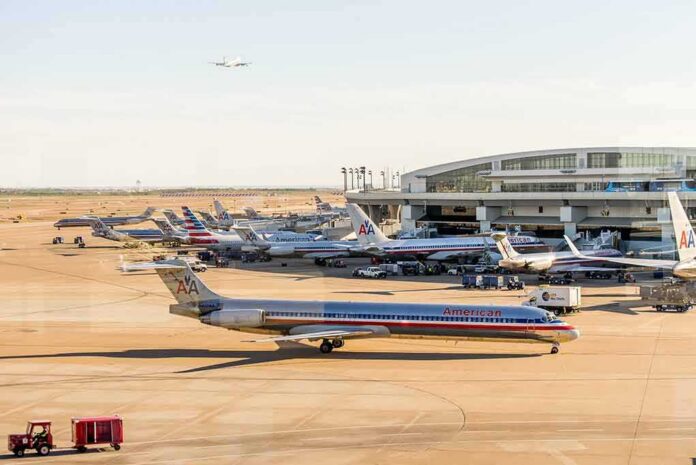
After a week of backlash and a funding threat from Texas’ governor, Dallas Fort Worth International Airport scrapped its plan to add Islamic ablution stations in Terminal D restrooms.
Story Snapshot
- DFW canceled a proposal to add two ablution stations inside Terminal D restrooms after political pushback.
- Texas Governor Greg Abbott warned that government facilities cannot favor one religion and ordered a grant review.
- Airport records and past releases show DFW has hosted ablution facilities near its chapel since 2019.
- The dispute reflects a wider fight over religious space in public infrastructure and equal treatment claims.
What DFW Planned And Why It Collapsed
Dallas Fort Worth International Airport filed plans to add two ablution stations inside men’s and women’s restrooms in Terminal D. The filing described a small renovation and a cost figure that drew fast attention. Within days, Governor Greg Abbott declared such faith-specific accommodations unlawful at a public airport and ordered a review of state grants. Soon after, DFW said it would not move forward with the restroom plan, ending the proposal amid the storm.
Abbott argued that a government-owned airport cannot favor one religion over others. He said the plan singled out one group for special treatment and referred the airports to the United States Department of Transportation for review. His public statement raised the stakes beyond a facilities choice and into constitutional and funding territory. The grant review warning added leverage that few public authorities can ignore, especially when budgets are tight and politics are heated.
DFW’s Existing Chapel Facilities And The Confusion Over “New”
Airport officials noted that DFW already offers ablution facilities next to its Terminal D interfaith chapel. In 2019, the airport announced the relocated chapel had added two ablution stations for ritual purification. That history helps explain why some at DFW described the restroom plan as a service expansion rather than a brand-new religious feature. The difference matters, because a station beside a multi-faith chapel can be seen as part of a shared space rather than a restroom retrofit.
Local coverage also showed shifting claims about who would pay. Some early chatter framed the project as privately funded. Later reporting cited the airport saying the filing’s funding note was inaccurate and that the project remained internal and unapproved. These mixed signals fed public suspicion about process and transparency. When government bodies change or correct filings mid-debate, people across the spectrum tend to assume the worst and question who benefits, who pays, and why now.
Why This Fight Resonated Nationally
Airports across the country have long maintained chapels or quiet rooms for travelers and staff. In 2015, Pew Research Center found that more than half of the busiest U.S. airports had dedicated chapels. Many facilities add small features, like wash areas or storage, to serve common needs of users. But when a feature is described as single-faith, it can look like endorsement, not inclusion. That framing shift often turns simple upgrades into political flashpoints with legal risk.
Critics in this case saw the restroom stations as special treatment, not neutral service. Supporters saw them as a practical way to keep bathrooms cleaner and safer while respecting faith needs. Both sides claimed fairness. The quick cancellation suggests risk managers at DFW judged the costs—legal, political, and financial—too high. The episode shows how fast local facility plans can become national culture fights when leaders and media amplify them to score points in wider battles.
What Equal Treatment Could Look Like Going Forward
Public airports can reduce conflict by building faith-related amenities into clearly shared, multi-faith spaces. Posting neutral rules, sharing cleaning and access standards, and routing water-safe fixtures near chapels may ease concerns about favoritism. Clear funding lines and public votes on visible features can also help. Courts often look at the total setup, not one sign or sink in isolation, when judging whether a government venue stayed neutral toward religion.
DFW airport, and Houston’s Bush airport, have had “Wudu ablution stations” for years. This was about adding additional ones. They shouldn’t have any, but they do.
“The airport has offered two ablution stations on the post-security side of Terminal D since 2019, when it…
— Bobby Halstead (@bobby_halstead) August 15, 2026
For travelers, the bottom line is service and safety. For taxpayers, trust rises when leaders show the math, cite the law, and invite open comment before they build. The DFW reversal highlights a deeper concern that both conservatives and liberals share: decisions at public hubs often feel rushed, opaque, and driven by elites far from everyday needs. Transparent processes and even-handed designs will not end every fight, but they can keep routine upgrades from turning into another political brawl.
Sources:
foxnews.com, dfwairport.com, youtube.com, voz.us, apnews.com