
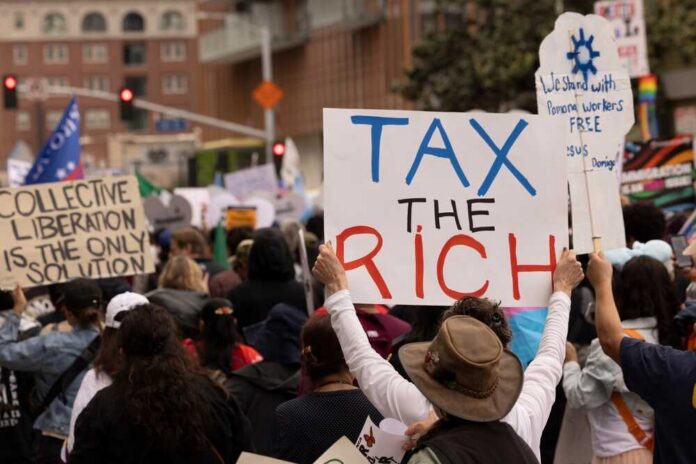
Some of America’s richest people are now publicly demanding a new wealth tax—and using that spotlight to pressure other billionaires to stop resisting and start paying more.
Story Snapshot
- Wealthy signatories behind “Proud to Pay More” and similar campaigns have urged governments to tax extreme wealth, arguing philanthropy is not a substitute for public revenue.
- Sen. Bernie Sanders is pushing a 5% annual wealth tax on America’s 938 billionaires, projecting $4.4 trillion in revenue over 10 years.
- A California billionaire wealth-tax ballot push backed by unions has become a national test case, with debate over whether the wealthy would relocate to avoid it.
- The fight reflects a broader public distrust: many Americans on left and right believe the system is rigged to protect elites, regardless of which party holds power.
Elite “tax us” campaigns collide with populist distrust
Organizations such as Proud to Pay More and long-running networks like Patriotic Millionaires have built a media-friendly message: tax the super rich, including us. Their letters—often timed to coincide with the World Economic Forum in Davos—argue that extreme private wealth is politically destabilizing and that voluntary giving cannot replace the legitimacy of democratically raised revenue. The unusual twist is the messenger: high-net-worth people publicly rejecting the usual billionaire talking points.
For conservatives, the pitch lands in a complicated place. Many voters already believe Washington wastes money and uses “fairness” rhetoric to justify expanding government. Yet the same voters also see a two-tier system in which connected corporations and the wealthy hire armies of lawyers and lobbyists to carve out special treatment. When millionaires say “tax us,” it can read less like sacrifice and more like an attempt to steer policy toward new bureaucracies—while preserving the broader rules of the game.
Sanders’ 5% billionaire wealth tax becomes the policy anchor
Sanders has turned the cultural moment into a concrete federal proposal: a 5% annual wealth tax on America’s 938 billionaires, whose combined net worth he places above $8.2 trillion. He argues the revenue—estimated at $4.4 trillion over a decade—could fund large expansions of public programs and offset costs that families feel in childcare, housing, and healthcare. His core claim is political: that billionaires’ effective tax burdens can be lower than ordinary workers’.
That argument, however, runs into a practical conservative question: what exactly is being taxed, and who decides the valuation? A wealth tax is not a simple income levy; it requires government to assess complex, often illiquid assets year after year—private companies, venture stakes, real estate portfolios, art, and other holdings. Even many voters who want elites to contribute more worry that such a system could expand federal power, create new loopholes for the well-advised, and increase pressure on entrepreneurs whose “wealth” exists on paper.
California’s ballot fight tests “they’ll leave” warnings
California has become the most visible state-level proving ground. Unions, including SEIU-United Healthcare Workers West, have pushed a ballot initiative built around a 5% annual wealth tax on billionaires, promoted as a way to stabilize funding for public services. Supporters frame the measure as modest relative to billionaire fortunes. Opponents and skeptics focus on mobility: if residency changes, asset shifts, or business relocation follow, the expected revenue could fall short while the broader economy absorbs uncertainty.
What the “tax the rich” split reveals about governance
The deeper story is not just left-versus-right tax ideology, but a growing crisis of confidence in institutions. Sanders points to the political influence of ultra-wealthy donors, while pro-tax rich campaigns argue inequality threatens democratic stability. Many conservatives agree the country is drifting from founding principles, but often diagnose the cause as a powerful administrative state, globalized corporate alignment, and policy capture that favors insiders. Both sides, in different language, describe the same fear: a government that serves itself.
In that environment, billionaire-on-billionaire finger-pointing can feel like theater unless it produces reforms that are simple, enforceable, and broadly fair. The University of North Carolina’s tax analysis underscores that the wealthy already pay substantial amounts in taxes, complicating slogans that suggest otherwise. That does not settle whether the code is equitable or efficient, but it does highlight the risk of policymaking driven by viral narratives rather than careful design. With Republicans controlling Washington in Trump’s second term, the next debate will test whether reform can target loopholes without building a new entitlement state.
Sources:
Yes, the rich must start paying their fair share of taxes
Billionaires’ wealth tax… save democracy
The rich do pay taxes and other little-known facts