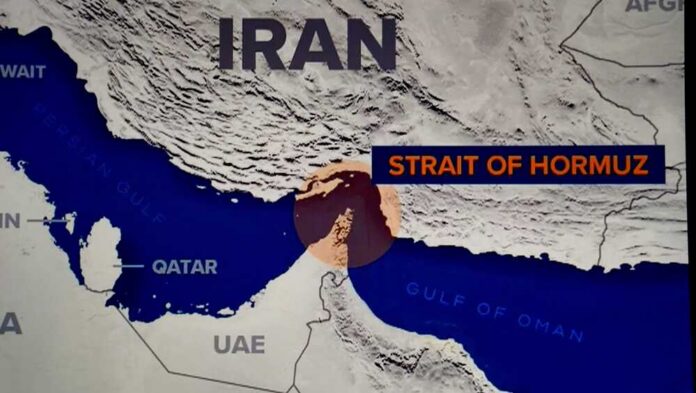
Iran threatens “decisive and immediate response” against British and French warships in the Strait of Hormuz, risking a spark that could ignite global oil chaos and undermine America’s energy independence victories.
Story Snapshot
- Iran’s Deputy Foreign Minister Kazem Gharibabadi warns UK and French naval deployments will face armed forces retaliation.
- HMS Dragon, a British Type 45 destroyer, stations in the strait alongside French warships to protect shipping lanes.
- Tensions follow recent U.S. strikes on Iranian oil tankers, with IRGC claiming missiles locked on American targets.
- Strait handles 21 million barrels of oil daily, threatening price spikes and economic fallout if disrupted.
Iran’s Direct Warning to Western Navies
Iran’s Deputy Foreign Minister Kazem Gharibabadi posted on X that British and French warships deployed to the Strait of Hormuz under the guise of protecting shipping will meet a decisive and immediate response from Iran’s armed forces. He condemned the moves as escalation tied to U.S. actions in the strait, which Iran calls illegal. Gharibabadi urged Britain and France not to complicate the situation further. This rhetoric echoes Iran’s historical claims over the vital waterway.
Western Deployments Amid Post-Strike Tensions
Britain deployed HMS Dragon, a Type 45 destroyer, to the Strait of Hormuz around May 10, 2026, with French warships joining to safeguard commercial shipping. These actions counter perceived Iranian threats following U.S. and Israeli strikes on Iranian oil tankers in early May. A fragile ceasefire holds, bolstered by diplomatic efforts from Saudi Arabia, Qatar, Russia, and Pakistan. The IRGC has declared its missiles and drones locked on U.S. vessels, heightening risks of miscalculation.
Strategic Importance of the Strait of Hormuz
The 21-mile-wide Strait of Hormuz between Iran and Oman channels about 21 million barrels of oil per day, roughly 20-30% of global trade. Iran has long asserted partial sovereignty, enforcing passage rules while threatening closure during crises, as in the 1980s Tanker War. Past incidents include Iran’s 2019 seizure of a UK-flagged tanker in retaliation for a British detention. Current deployments aim to uphold freedom of navigation but provoke Iran’s asymmetric capabilities like speedboats and mines.
Experts from Reuters describe the warning as deterrence signaling, similar to 2019 patterns, while CSIS notes Iran’s edge in strait warfare. UK and French actions appear symbolic yet provocative, supporting U.S. maximum pressure on Iran. No confrontations reported as of May 11, 2026, but the standoff tests President Trump’s second-term strategy of countering Iranian aggression without full-scale war.
Iran warns British warships deployed to the Strait of Hormuz will be met with ‘decisive response’ – https://t.co/HbwnVv1XLI https://t.co/PZfWXbi2nO
Follow @NewsHubGlobe for 24/7 breaking news from around the world. pic.twitter.com/rwBpEnkmm0
— News Hub (@NewsHubGlobe) May 11, 2026
Economic Risks and Broader Implications
A naval skirmish or strait closure could spike oil prices 5-10% short-term from a $90 per barrel baseline, with prolonged disruption pushing Brent above $150 and risking recession. Daily trade exceeds $100 billion, affecting Gulf exporters like Saudi Arabia and importers in Europe and Asia. U.S. LNG exports to Europe could accelerate diversification. For Americans weary of high energy costs from past renewable mandates, this underscores the need for domestic fossil fuel dominance to shield against foreign volatility.
Both conservatives frustrated by globalist entanglements and liberals concerned over elite-driven conflicts share unease with endless foreign adventures. Iran’s bluster, amid internal regime weaknesses, highlights how distant powers threaten everyday Americans’ pursuit of the dream through stable prices and secure supply chains. Mediators push diplomacy, but accidental escalation remains a peril in this chokepoint.
Sources:
Iran warns UK, France against Hormuz warship deployment – Iran International
Iran warns of response to French and British warships in Hormuz – Middle East Eye