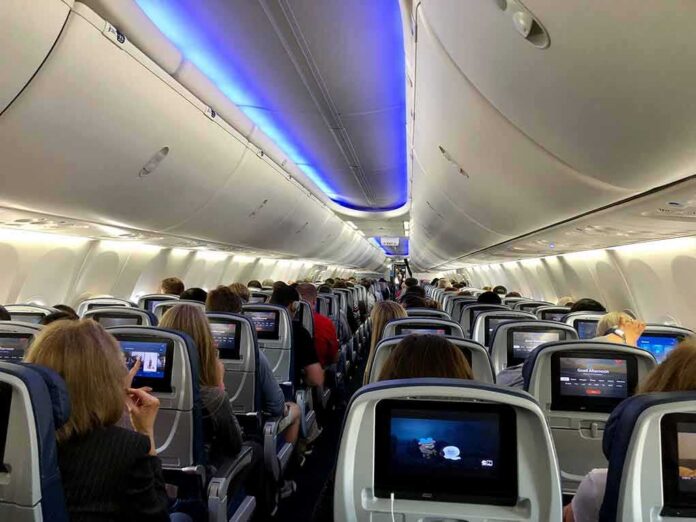
On a packed flight, a father who refused to pay for family seating tried to bully a woman out of her £150 seat—and ran straight into the hard limits of airline rules and public patience.
Story Snapshot
- A woman who paid £150 for a plane seat refused to swap when a father demanded her spot so he could sit with his kids.
- The dad had chosen not to pay for family seating, then leaned on guilt and pressure instead—only to be “humbled” when she stood firm.
- Airline experts say passengers are never required to give up paid seats for families; swaps are voluntary and must be fair.
- This flashpoint highlights a bigger problem: airlines sell seat choice like a luxury, then leave families and other passengers to fight it out in the cabin.
The Seat Swap Showdown
On a recent flight, a solo female passenger had paid about £150 for a specific seat, likely to secure comfort and predictability on a crowded plane. A father who had booked seats for himself and his children without paying extra for them to sit together then approached her, demanding she give up her seat so he could be closer to his kids. He framed his request as a moral issue, suggesting any decent person would help a family, even though he had declined to pay for the same guarantee she had bought.
When she calmly refused, citing the money she spent and her right to stay where she was, the father grew more aggressive, attempting to shame her in front of nearby passengers. Reports say he tried “petty revenge” tactics, such as loudly complaining and making her out to be selfish. Yet other passengers eventually backed her, and the situation “quickly humbled” him when it became clear the crew would not force a swap and most people saw his demand as entitled, not noble.
What The Rules Actually Say About Seat Swaps
Stories like this strike a nerve because many people assume there is some rule that says you must help a family sit together. But travel experts and airline commentators are blunt: the seat printed on your boarding pass is yours, and you are never required to give it up for another passenger. A common guidance from travel advocates is that families “should sit together, but not by unfair seat swaps,” especially when one person paid extra for a better seat and the other did not.
Most airlines treat passenger-to-passenger swaps as purely voluntary and subject to crew approval, mainly for safety and cabin-class reasons. The U.S. Department of Transportation and several major carriers have moved toward guarantees that children under 13 will be seated with an adult on the same reservation, but that duty is on the airline and the booking process, not on random strangers who bought preferred seats. A survey of travelers found nearly nine in ten believe passengers should keep their booked seats unless there is a truly valid reason to change them, which matches how people reacted on this flight.
How Airlines Created This Conflict
This clash did not appear out of thin air. For years, airlines have “unbundled” flying, turning seat selection into an extra product instead of a basic part of the ticket. The UK Civil Aviation Authority has warned that if you do not pay for an allocated seat, sitting with your companion or group “is not guaranteed,” yet airlines still allow families to book cheap fares and then hope other passengers will fix the problem on board. That business model shifts the burden from companies to customers, who end up negotiating in a cramped metal tube at 30,000 feet.
At the same time, contracts of carriage give airlines broad power to move seats around for operational reasons, while offering little protection beyond refunds if you lose a paid seat perk. Regulators say your ticket buys you transport in a cabin class, not a specific seat number. That means airlines can change planes or shuffle seat maps, but they do not create any legal duty for one passenger to sacrifice their seat for another’s comfort. It is a system that often feels rigged in favor of the airline and against ordinary travelers trying to protect the little bit of control they can afford.
Why This Story Resonates Across The Political Divide
For many Americans, this story hits a familiar nerve: people who plan ahead and pay their way feel punished, while those who game the system or rely on guilt often seem protected. Conservatives see it as another small example of rules being bent for people who do not take responsibility, echoing frustrations about government overspending, special treatment, and a culture that shames self-reliance. Liberals see yet another case where big companies set up conflict and walk away, feeding the sense that ordinary families and workers are squeezed while elites stay insulated.
Airlines profit from selling certainty but then write contracts that keep them flexible and keep you vulnerable. They charge extra for basic fairness—like sitting with your child—then leave strangers to work out moral questions that should have been solved at the booking page. Etiquette experts now stress that it is “not wrong” to keep the seat you paid for and that pressuring people with guilt or social media shaming is inappropriate. In the cabin, as in politics, many feel like the real fight is not left versus right, but regular people versus systems that create chaos and then blame the passengers caught in the middle.
Sources:
mirror.co.uk, joe.co.uk, dailymail.co.uk, liveandletsfly.com, gov.uk, youtube.com, reddit.com, ia600607.us.archive.org, caa.co.uk, foxnews.com, photoaid.com, transportation.gov, splashtravels.com, mightytravels.com, thetraveler.org