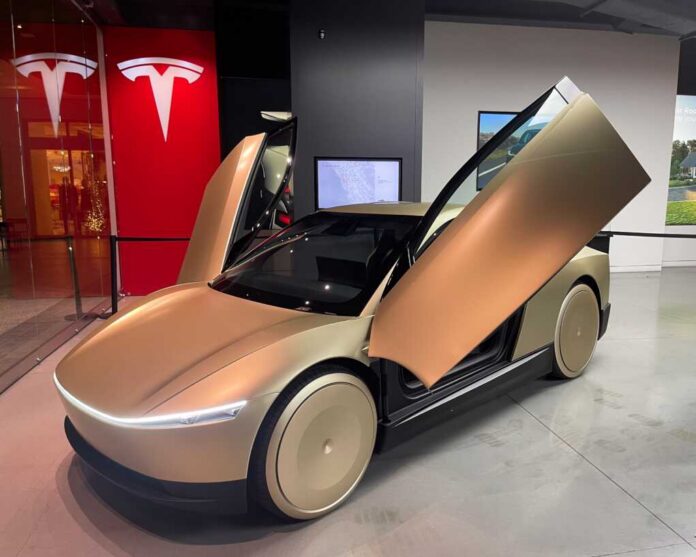
Tesla just rolled the first steering wheel-less, fully autonomous Cybercab off the production line at Gigafactory Texas, marking a bold leap toward a robotaxi future that could revolutionize American transportation—or face regulatory roadblocks that threaten innovation.
Story Snapshot
- Tesla completed its first production Cybercab robotaxi at Gigafactory Texas on February 17, 2026, with no steering wheel, pedals, or mirrors—designed solely for autonomous driving.
- The two-seat vehicle uses a cost-cutting “unboxed” manufacturing process and is priced around $25,000, targeting high-volume robotaxi deployment starting April 2026.
- Regulatory uncertainty looms as federal safety standards assume human controls, though competitor Zoox received exemptions for similar steering wheel-less designs.
- Tesla’s existing Model Y robotaxi fleet in Austin shows crash rates four times higher than human drivers, raising questions about Full Self-Driving readiness ahead of Cybercab deployment.
First Cybercab Reaches Production Milestone
Tesla announced on February 17, 2026, that the first production Cybercab completed assembly at Gigafactory Texas in Austin. CEO Elon Musk congratulated the team via social media, sharing a photo of employees gathered around the two-seat, autonomous vehicle. Unlike traditional cars or Tesla’s Model Y robotaxi trials, the Cybercab eliminates steering wheels, pedals, and side mirrors entirely, relying exclusively on camera-based Full Self-Driving technology. This design reflects Tesla’s vision for a purpose-built robotaxi optimized for ride-hailing rather than personal ownership, though customers will eventually have purchase options at the projected $25,000 price point.
The milestone follows extensive testing across Texas, California, New York, and harsh winter conditions in Buffalo and Alaska. Prototype units included manual controls during validation, but the production version strips these features to reduce manufacturing costs and complexity. Tesla expects continuous volume production to begin in April 2026, though Musk warned the ramp-up will initially be slow due to new parts and assembly processes before accelerating rapidly. This first unit signals Tesla’s intent to compete directly with Waymo and Amazon’s Zoox in the autonomous ride-hailing market, leveraging Gigafactory Texas’s expanded capacity and innovative manufacturing techniques.
Unboxed Manufacturing Cuts Costs and Complexity
The Cybercab employs Tesla’s “unboxed” manufacturing process, assembling modular sections separately before final integration—a departure from traditional assembly lines. This approach reduces the vehicle to roughly half the parts of a Model 3, cutting production time and expenses while enabling the sub-$30,000 target price. Gigafactory Texas houses dedicated facilities for this method, including an Autonomous Testing and Development lab expected to open by June 2026 for crash testing and safety validation. By simplifying the design around autonomy rather than human operation, Tesla aims to achieve cost efficiencies that legacy automakers and competitors relying on lidar sensors cannot match with vision-only systems.
The Cybercab’s camera-based architecture aligns with Tesla’s long-standing bet on Full Self-Driving software, contrasting sharply with rivals using expensive lidar arrays. All exterior cameras feature integrated washers to maintain visibility in adverse weather, a critical reliability factor for year-round operations. This design philosophy underscores Tesla’s confidence in scaling vision-based autonomy, though critics note the technology still lacks federal certification for fully driverless operation. The unboxed process also positions Tesla to produce the Cybercab alongside next-generation vehicles like the Cortex, maximizing factory output and reinforcing Texas’s role as the company’s manufacturing hub for autonomous innovations.
Regulatory and Safety Hurdles Remain Unresolved
Federal motor vehicle safety standards currently assume human drivers will operate vehicles, requiring steering wheels and pedals by default. Tesla has not disclosed whether it will seek exemptions similar to those granted to Zoox, which operates limited steering wheel-less robotaxis in Las Vegas and San Francisco. Without regulatory approval, the Cybercab cannot legally operate on public roads for passenger service, delaying deployment despite production readiness. State-level rules on insurance, registration, and liability for autonomous vehicles add further complexity, particularly in Texas and California where Tesla plans initial rollouts. These uncertainties represent a tangible threat to innovators pushing boundaries, as bureaucratic inertia could stifle American leadership in autonomous technology.
Tesla says the first Cybercab just rolled off the production line at Gigafactory Texas https://t.co/zdtp08U2RL
— BargainBest777 (@nataliecorri) February 18, 2026
Safety concerns amplify regulatory scrutiny. Tesla’s existing Model Y robotaxi fleet in Austin, comprising roughly 40 vehicles, recorded crash rates four times higher than human-driven cars in recent data. While unsupervised public rides began in January 2026, the fleet’s 19 percent availability and elevated accident frequency raise questions about whether Full Self-Driving software is sufficiently mature for the Cybercab’s no-controls design. Tesla maintains a backup plan to add manual controls if needed, but such a reversal would undermine the cost savings and design philosophy driving the project. For Americans valuing innovation and free-market solutions, these challenges highlight the tension between pioneering technology and government-imposed safety mandates that may prioritize caution over progress.
Sources:
Tesla says the first Cybercab just rolled off the production line at Gigafactory Texas – Business Insider
Tesla Cybercab: First unit rolls off Giga Texas production line – Teslarati
First Tesla Cybercab Rolls Off Production Line at Giga Texas – Not a Tesla App
Tesla unveils first Cybercab built in Texas – Electrive
First Tesla Cybercab rolls off production line at Giga Texas – Tesla Hubs
Tesla rolls first steering wheel-less Cybercab unit off the line before solving autonomy – Electrek
First Tesla Cybercab from Texas Gigafactory Production Line – Next Big Future