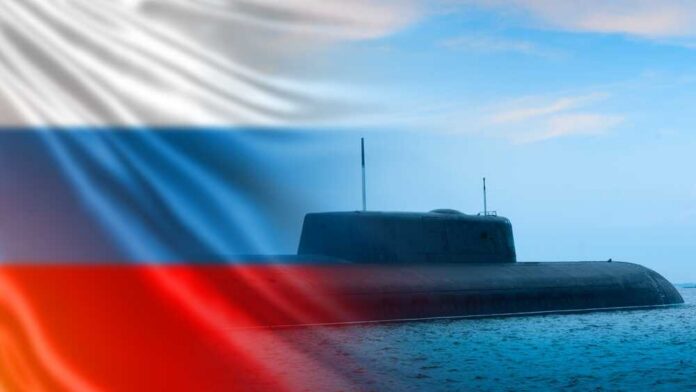
Russia operates the world’s only titanium-hulled submarines still in service—a technological marvel the U.S. Navy possessed the capability to build but deliberately chose not to replicate, raising questions about whether American strategic choices made decades ago remain sound in today’s evolving naval landscape.
Story Snapshot
- Russia’s Sierra-class submarines feature titanium hulls enabling diving depths exceeding 550 meters and speeds of 34 knots—capabilities unmatched by any current U.S. submarine
- The U.S. Navy deliberately rejected titanium technology despite having the metallurgical expertise and industrial capacity, choosing instead to prioritize acoustic stealth and production numbers
- Only two Sierra II boats were ever built due to titanium’s extreme manufacturing costs and complexity, validating the American decision to focus on mass-produced steel submarines
- Four decades later, American submarines maintain undersea dominance through superior quietness and sensor technology rather than diving depth, proving strategic philosophy matters more than exotic materials
The Soviet Gamble on Titanium Technology
The Sierra-class submarine entered Soviet service in 1984 as the culmination of decades-long efforts to build titanium-hulled attack submarines. These boats featured an inner titanium pressure hull surrounded by an outer hydrodynamic casing, enabling them to dive deeper and move faster than their American counterparts. The design incorporated a single OK-650 pressurized water reactor, replacing the exotic and troublesome reactor of the earlier Alfa-class. Soviet engineers accepted the enormous costs and manufacturing complexity of working with titanium to achieve a specific mission: hunting American ballistic missile submarines on deterrent patrol at depths where conventional steel-hulled boats could not follow.
America’s Calculated Strategic Rejection
The U.S. Navy possessed the same titanium technology, metallurgical expertise, welding capabilities, and industrial base necessary to construct titanium-hulled submarines. American engineers understood the performance advantages titanium offered: reduced weight, greater structural strength, lower magnetic signature, and superior diving depth. Yet Navy leadership made a deliberate decision to reject this path entirely. Instead, they invested resources in developing quieter steel-hulled submarines with superior acoustic sensors and built them in numbers the Soviet titanium fleet could never approach. This choice reflected a fundamental strategic calculation: in undersea warfare, the ability to detect your enemy before being detected matters more than how deep you can dive.
The High Cost of Soviet Ambition
Only two Sierra II-class submarines were ever constructed, a telling limitation that exposed the fundamental weakness of the Soviet approach. Titanium proved notoriously finicky to work with, requiring specialized manufacturing facilities, highly trained welders, and extensive quality control measures. The material’s high costs and processing complexity made sustained production economically prohibitive even for a superpower committed to military competition. By contrast, the U.S. Navy maintained a well-established industrial base for building steel submarines, with decades of accumulated experience and mature supply chains. This industrial reality enabled America to field larger numbers of capable submarines while the Soviets struggled to produce even a handful of their titanium boats.
Validation Through Dominance
By 1990, American submarines had achieved decisive dominance in the undersea environment not through exotic materials but through superior operational capabilities. They were quieter than their Soviet counterparts, making them far harder to detect with passive sonar. They carried better sensors that could locate enemy submarines at greater ranges. They were built in sufficient numbers to maintain presence across critical maritime domains. The Sierra-class, despite its impressive technical specifications, created detection challenges for American magnetic anomaly detection systems and sonobuoy fields, yet these obstacles did not prevent U.S. boats from neutralizing the threat. Four decades later, the calculation that led to America’s strategic choice still appears correct—a remarkable validation of design philosophy over technological showmanship.
‘We Can’t Build Them’: The U.S. Navy Has Nothing Like Russia’s Sierra-Class Titanium Submarineshttps://t.co/5mw3bXm0Ke
— Harry J. Kazianis (@GrecianFormula) April 26, 2026
Lessons for Today’s Naval Competition
The Sierra-class story carries significance beyond Cold War history. It demonstrates that in military competition, strategic choices about resource allocation often matter more than individual technological achievements. The Soviet Union invested enormous resources developing an impressive capability that produced minimal operational advantage. America focused on practical advantages that translated directly into combat superiority. Today, as the U.S. Navy faces budget constraints and competing priorities, the Sierra-class experience offers a cautionary tale about the seductive appeal of exotic technologies versus the unglamorous reality that winning wars requires fielding capable systems in adequate numbers. The Sierra II boats remain operational in the Russian Navy, technological artifacts of Soviet ambition—impressive in specification but limited in impact.
Sources:
‘We Can’t Build Them’: The U.S. Navy Has Nothing Like Russia’s Sierra-Class Titanium Submarines
Russia’s Sierra II-Class Titanium Submarine: US Navy Can’t Match
Why US Navy Can’t Match Russia’s Sierra II Titanium Submarine
The Navy Never Built Deep Diving Titanium Nuclear Submarines Like Russia
Russian SIERRA Class Titanium-hulled Attack Sub