

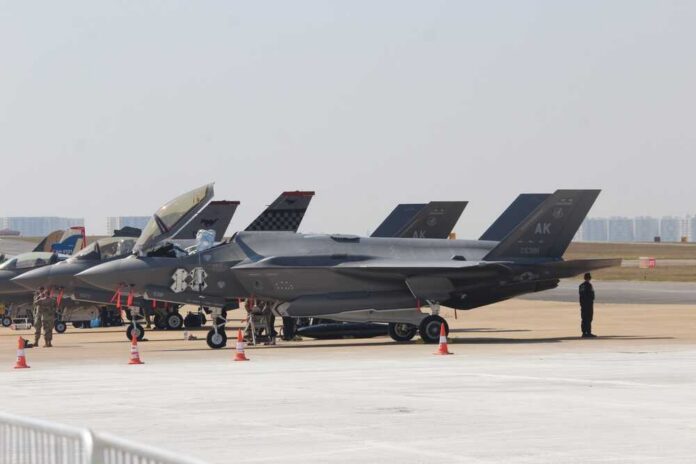
Washington’s quiet plan to cut jets, bombers, ships, and drones for NATO crises signals a major shift—and a bigger test for Europe.
Story Snapshot
- Reports say the United States will scale back key forces assigned to NATO during crises [1].
- Officials reportedly briefed allies; timelines and exact levels are still being finalized [1].
- Coverage describes cuts to bombers, fighter jets, warships, submarines, and drones [1][3].
- Supporters call it burden-sharing; critics warn of weaker deterrence [1][3].
What The United States Told Allies And What May Change
Reports say United States officials told NATO policy directors that Washington plans to scale back forces the alliance can count on in a crisis. The list includes strategic bombers, fighter jets, drones, submarines, and warships [1]. The reporting says the Pentagon adviser who briefed allies did not offer a firm timeline. The posture is still being finalized [1]. German public media coverage adds that the nuclear deterrent remains, but conventional assets would shrink [3]. That mix suggests a planned shift, not a total break.
Follow-on summaries describe rough categories rather than exact numbers. That is common in early posture signals. The point is to set expectations and push planning, while leaders keep options open. The reports say allies were told to prepare gap-filling plans [1]. That implies the United States still aims to deter threats with NATO. But it also means Europe will need more of its own planes, ships, crews, and ammunition ready to go fast, without a large American backstop in the first days of a crisis.
Why This Fits A Long Fight Over Burden-Sharing
Past United States administrations, from both parties, have pressed Europe to spend more on defense. This story follows that pattern. The reported cuts look like a lever to make allies carry more of the load [1]. Supporters argue European members are richer, closer to the fight, and must field more of the jets, ships, and air defenses they rely on the United States to supply. Critics answer that sudden shifts risk confusion and weaken deterrence if gaps appear before Europe can fill them [3].
Public comments also point to a real posture change, not just talk. Reports cite statements that the United States troop presence in Europe is being adjusted in coordination with allies. That signals ongoing planning and allied input, but also confirms movement on the ground [3]. For many readers, this hits a nerve. People on the left and the right see a pattern where big moves are announced in elite rooms first, while taxpayers face higher costs and fewer clear answers.
What Could Shrink, And What Stays
Coverage outlines cuts to several high-demand tools. These include strategic bombers that strike deep, fighter jets that police skies, warships that protect sea lanes, submarines that hunt enemy fleets, and armed drones that watch and hit targets [1][3]. Reports also describe fewer aerial refueling aircraft in the mix [1]. At the same time, the nuclear umbrella would remain. That means Washington keeps the ultimate backstop, while scaling down day-to-day conventional muscle that often decides the first week of a fight [3].
🚨🇺🇸 The United States is planning to significantly reduce its military commitment to NATO in Europe, including major cuts to fighter jets, warships, and aerial refueling tankers, according to reports.
These planned reductions in assets like F-16s and aircraft carriers aim to… pic.twitter.com/y5mjowBMkW
— Mazi okwuoma (@MaziEzike_Nedu) June 12, 2026
This balance matters. Nuclear weapons deter the worst-case attack. Conventional forces deter the more likely test: a fast land grab, a blockade, or strikes on ports and power. If bombers, fighters, and ships are thinner, then any delay in Europe’s replacements becomes a real risk. That is why the timeline and the allied build-out plan matter more than the headline. Reports say those details are still in flux [1]. Until they are clear, doubts will grow on both sides of the Atlantic.
What It Means For Voters Who Feel Let Down
Americans across parties say leaders dodge hard tradeoffs. This move forces them into the open. If Europe steps up with more spending, faster buys, and better readiness, the plan could ease United States strain and lower long-term costs. If not, the alliance could face more danger with less backup. The path should be simple to explain: who pays, who fields what, and by when. So far, the public has partial answers and leak-driven details [1][3]. That fuels the trust gap many already feel.
Sources:
[1] Web – US plans to slash fighter jets, warships to NATO in Europe: report
[3] YouTube – US To Break NATO’s Backbone? Trump Mulls Slashing Fighter Jets …