
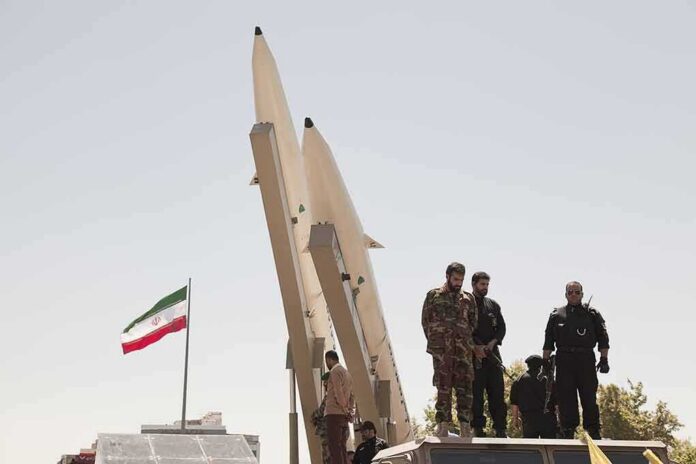
U.S. court filings and recent security actions show Iran-linked plots have moved from intimidation to alleged murder-for-hire against Americans, with officials now warning of advanced efforts overseas.
Story Snapshot
- Federal cases since 2021 outline alleged Iranian-directed kidnappings and murder-for-hire on U.S. soil.
- Justice Department linked a senior Iranian security official to a New York assassination plot in 2024.
- U.S. bombers left a British base amid concerns over an Iran-linked threat near the installation.
- Analysts describe a long pattern of Iranian transnational repression against dissidents abroad.
What U.S. Prosecutors Say Has Changed
Justice Department documents lay out a steady shift from harassment to kidnap plots and then to alleged murder-for-hire. In 2021, a New York indictment charged Iranian intelligence figures with plotting to kidnap a U.S.-based journalist and activist in Brooklyn, describing the effort as directed by the Government of Iran. In 2023, a superseding indictment alleged an Eastern European criminal group was hired to kill a U.S. citizen in New York after earlier kidnap efforts failed. Those charges mark an escalation in both means and risk.
Federal filings in 2024 tied the alleged network to a named senior security figure. The Justice Department announced murder-for-hire charges against an Islamic Revolutionary Guard Corps brigadier general and others, alleging they contracted a criminal organization to kill a U.S. citizen who criticized Iran’s government. A related U.S. Attorney announcement in Manhattan detailed the alleged role of that general and a former intelligence officer in directing the plot. These attributions raise stakes for dissidents and authorities alike.
Threat Picture Beyond U.S. Borders
Recent reporting from the United Kingdom shows how U.S. and allied militaries are treating potential threats as real-time concerns. Twelve U.S. B-1 bombers deployed at Royal Air Force Fairford returned to home stations after arrests near the base and warnings of a suspected Iran-linked plot targeting the installation, according to coverage that cited officials. Authorities confirmed the bomber redeployment. The public reporting does not include charging documents, but the force-protection steps indicate operational caution by commanders.
Officials say the broader issue reflects a long-running pattern. Human rights researchers describe Iran’s “transnational repression,” a mix of intimidation, rendition, and attacks on dissidents abroad, as a sustained practice that spans decades and regions. This history gives weight to fresh warnings, even as each new case must stand on its own evidence. The documented U.S. indictments focus on journalists and activists, which shows capability, but does not prove a distinct campaign against military personnel by itself.
What The Cases Establish—and What They Do Not
Public court records now anchor several concrete claims. They describe alleged plots in 2020, 2021, and 2022 that targeted the same U.S.-based critic across multiple attempts, first with kidnapping and then with a contracted killing. They also include 2024 charges that name a brigadier general as part of the alleged network behind a murder-for-hire plan. These filings do not decide guilt, but they show the Justice Department’s evidence and theory of the cases to date.
🚨🇺🇸🇮🇷 IRAN | US INTEL CHIEF: IRAN'S LETHAL PLOTS VS AMERICANS AT "ADVANCED STAGES"
DNI Jay Clayton told Rubio in a memo that Iran has "substantially increased efforts to target U.S. personnel" in the Middle East and other countries.
Source: CBS News, Axios pic.twitter.com/XYYRQdvFwZ
— Deeploomatic (@Deeploomatic) October 24, 2026
Important limits remain. The public record does not provide a time series that quantifies how much Iranian plotting has grown, or by what measure “advanced” applies across cases. The strongest evidence concerns dissidents and U.S. residents, not uniformed personnel or diplomats. Reporting on the British base episode emphasizes serious precautions and arrests, but there are no parallel public charging documents to unpack alleged command links or specific operational steps. Those gaps call for careful reading of what is proven and what is asserted.
Why This Matters For Americans Across The Spectrum
For conservatives worried about national strength and the safety of troops, the bomber redeployment and named-attribution indictments signal that adversaries may be probing allied bases and targeting Americans abroad. For liberals concerned about human rights and government overreach, the focus on dissidents shows the human cost of repression that crosses borders. For many in the middle, this story fits a larger fear: faraway power plays can reach into American neighborhoods and allied towns, while Washington often reacts late.
What To Watch Next
Watch for trial developments and any release of supporting evidence in the kidnapping and assassination cases. Look for clarity on how officials count and define plots, including whether targets are dissidents, diplomats, or service members. Monitor allied force-protection moves and whether authorities in Britain publish charging documents related to the base incident. Each step will help the public judge risk with facts, not noise—and hold leaders to results, not press statements.
Sources:
cambridge.org, justice.gov, static.foxnews.com, pbs.org, ctc.westpoint.edu