

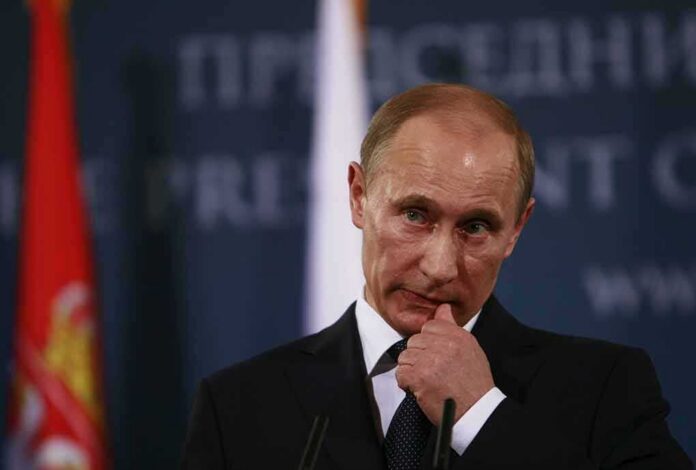
Vladimir Putin keeps saying he’s open to peace while his own army keeps fighting, and new research shows that gap may come down to one thing: his grip on power.
Story Snapshot
- A security research group says a Russian defeat would raise the risk that Putin gets pushed out of office, giving him reason to keep fighting.
- Putin himself says all peace proposals are “on the table,” but Russian officials keep repeating the same hardline demands.
- A Spanish defense analysis finds the war’s cost to Russia’s economy could eventually force Moscow toward a deal, even while Putin holds a tough public line.
- No leaked Kremlin document proves Putin privately fears for his life if the war ends — the case rests on outside analysis, not an inside confession.
Analysts Say Defeat Could Threaten Putin’s Grip
The Center for a New American Security, a Washington research group, tracks risks to Putin’s hold on power. Its latest update says a Russian loss in Ukraine would raise the odds Putin gets removed from office. The group concludes flatly that this “is why Putin has little interest in ending the war”. Ukrainian analyst Oleksandr Yizhak made a similar point, saying Putin sees continuing the fight as the safer path for his own survival.
Putin Publicly Says He’s Open to a Deal
Putin’s own words complicate that picture. He told reporters in September that “all proposals are on the table” and that Russia simply needs to weigh its own interests before agreeing to anything. Russian aide Yury Ushakov said Moscow’s goals “remain unchanged” while insisting Russia stays “ready for a political-diplomatic settlement” aimed at lasting peace. Those statements don’t sound like a man who believes any deal spells his downfall.
The Catch Hidden in Russia’s Demands
Battlefield analysts say Putin’s talk of peace comes loaded with conditions that look a lot like surrender terms for Ukraine. The Institute for the Study of War reported in June that Putin demanded Ukraine accept terms “that amounted to demands for Ukrainian capitulation”. By September, the same group said Putin still refused “meaningful compromises,” tying any deal to Ukrainian troop withdrawal, demilitarization, and a permanent ban on joining NATO. Willingness to talk and willingness to compromise are not the same thing.
At the Valdai forum in October, Putin claimed Russia was “deliberately pushed” into the war and argued a Russian “strategic defeat should not be set as a goal”. That framing lets him explain the war’s length as a defensive necessity, not a personal survival strategy. It also gives him room to reject any outcome critics might label a loss, without admitting the war was a mistake.
Russia’s War Economy Faces Growing Strain
A Spanish Ministry of Defence analysis warns that grinding attrition carries its own political danger for the Kremlin. The report says prolonged fighting creates “internal political, social, and economic risks” that could eventually push Moscow toward a negotiated exit, even as it tries to hold onto symbolically important territory like Donetsk and Luhansk. In other words, continuing the war isn’t automatically the safe choice — it could wear down the very stability Putin needs.
Why Outside Experts Can’t Prove Putin’s True Motives
No leaked Kremlin memo or sworn testimony confirms Putin privately believes ending the war would cost him his life or his office. The strongest claims come from research groups and quoted analysts interpreting his behavior from the outside, not from a document written inside his government. Russia’s tight control over information makes it hard for outsiders to know what Putin and his inner circle actually discuss behind closed doors.
Research on authoritarian leaders offers a broader clue. Studies on dictatorships show leaders who start wars often face bigger personal risks if they lose, and some double down rather than accept defeat because losing power could mean prison or worse. That pattern fits Putin’s situation, but it doesn’t prove he’s trapped. Russian elites themselves appear divided, with some reportedly favoring an end to the war and others pushing to keep fighting.
What emerges is not a simple story of a cornered dictator with no way out. It’s a leader managing competing pressures: an economy strained by war, a public that may accept a face-saving freeze as victory, and elites who don’t all want the same thing. For Americans watching Washington weigh its own role in ending the war, the lesson is that Putin’s calculations are murkier — and more self-interested — than either side’s talking points suggest.
🇺🇸🇺🇦 The Ukraine War: Can the United States Bring It to an End?
Strategic assessment | 14 October 2026 | Outlook: October 2026 – March 2027
The United States has substantial leverage to help end Russia's war against Ukraine, but Washington cannot impose a durable peace by itself.… pic.twitter.com/q3Mn6sRPkX— Letros Antonis (@AntonisLetros) October 14, 2026
Sources:
tsn.ua, stripes.com, english.ahram.org.eg, smh.com.au, reuters.com, understandingwar.org, 24tv.ua, aa.com.tr