

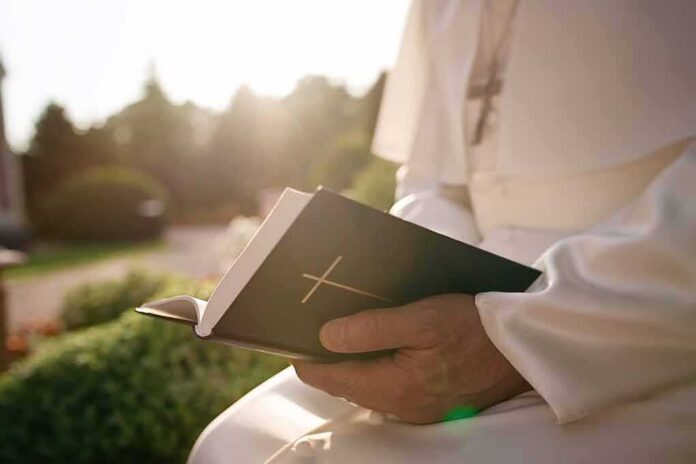
Doctors confirmed Pope Leo XIV has lung cancer after removing part of his right lung in a surgery the Vatican says went off without a hitch.
Quick Take
- The Vatican confirmed Pope Leo XIV has lung adenocarcinoma, found during surgery at Rome’s Gemelli Hospital.
- Surgeons removed the lower lobe of his right lung using a minimally invasive technique.
- The Vatican says the roughly 90-minute operation was successful with no complications.
- The Pope woke up normally and returned to his hospital room after a recovery period.
- Key details, like the cancer’s stage and whether it spread, have not been made public.
Doctors Confirm Diagnosis During Operation
Doctors Luigi Carbone and Stefano Margaritora said tests done during the surgery confirmed lung adenocarcinoma, a common type of lung cancer. The Holy See Press Office released the statement on October 13, 2026. Surgeons removed the lower lobe of the Pope’s right lung using a video-assisted technique, a less invasive method than traditional open-chest surgery.
The diagnosis did not come as a complete surprise to the medical team. Doctors said scans and tests done before the operation already pointed to a possible tumor. A fast tissue test performed during surgery then confirmed what those earlier results had suggested.
Vatican Describes Successful Operation
The Pope spent about three hours total in the operating room, with the actual procedure lasting around 90 minutes. The Vatican’s medical bulletin stated plainly: “The surgery was successful, and there were no complications.” News outlets including CNBC and PBS NewsHour repeated that exact language in their reporting on the operation.
After the procedure ended, Pope Leo woke up from anesthesia in a normal way, according to the Vatican. He was moved back to his 10th-floor hospital room following a standard observation period, a detail confirmed in multiple news reports on the day of the surgery.
What Remains Unknown About The Cancer
The Vatican’s statement does not say what stage the cancer reached or whether it spread beyond the removed section of lung. Doctors have not released lymph node results, tumor size, or margin status, information that typically determines whether a cancer patient needs further treatment like chemotherapy or radiation.
Medical researchers note that surgery alone is the standard first treatment for early-stage lung adenocarcinoma, with five-year survival rates for small, early tumors running as high as 97 percent. Without staging details, it is not possible to know where the Pope’s case falls on that range.
A Familiar Tension Over Leaders’ Health
Cases like this one highlight a recurring question that goes back decades: how much of a world leader’s medical history belongs to the public. In 1992, Senator Paul Tsongas ran for president while keeping a cancer recurrence private, a case still cited in debates over whether officials owe voters full medical transparency.
Medical ethics experts generally argue that patients, including public figures, have a right to privacy over details that don’t affect their ability to do their job. The Vatican’s approach so far mirrors that standard, confirming the diagnosis and surgical outcome while withholding granular medical records.
Looking Ahead For The Pope’s Recovery
Reports before the surgery noted the Pope faces a hospital stay of roughly a week, with implications for his travel schedule, including a planned trip to Latin America. How the Vatican handles updates in the coming weeks will likely shape public understanding of his recovery and any further treatment needs.
#PopeLeo diagnosed with lung #cancer as growth removed during surgery https://t.co/zKHdAJcr2u Pope Leo has lung cancer, the #Vatican said late on Tuesday. Leo, 71, underwent an operation and had the lower lobe of his right lung removed, with tests confirming a diagnosis of lung…
— Health Point (@aliya_Hshah) October 14, 2026
For now, the confirmed facts are straightforward: a cancer diagnosis, a completed surgery, and a Vatican declaring it successful. Whether that success extends to a full cure depends on pathology details the Vatican has not yet made public.
Sources:
youtube.com, vaticannews.va, dw.com, inquirer.com, nbcchicago.com