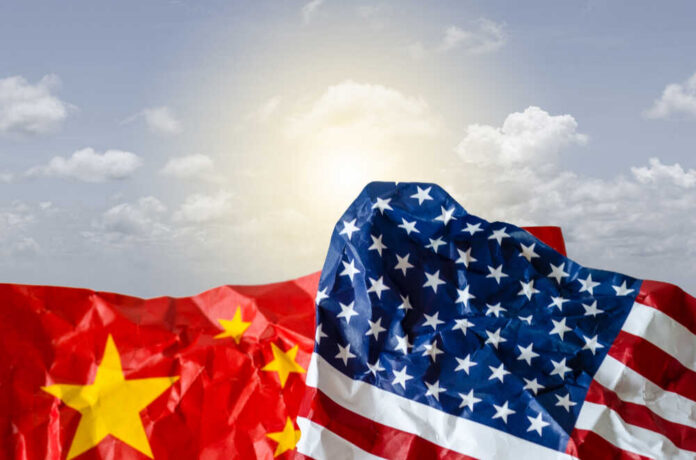
China’s massive AI push threatens America’s technological edge, exploiting eased U.S. export controls to close the gap in a race that endangers national security.
Story Snapshot
- U.S. maintains leads in advanced AI chips and frontier models, but China surges in industrial deployment at double the American rate.
- President Trump’s relaxed semiconductor export controls enable China’s rapid datacenter buildout, fueled by energy surplus exceeding U.S. capacity.
- China invests billions through state funds and tech giants like Alibaba ($53B) and ByteDance ($21B), prioritizing open-source diffusion into robots and factories.
- Experts warn U.S. “pilot purgatory” lags China’s scaled manufacturing AI adoption, risking long-term dominance in global supply chains.
U.S.-China AI Competition Heats Up
President Trump’s administration eased export controls on semiconductors and rare earths, allowing both nations to release new AI models and applications. The India AI Impact Summit in New Delhi this week spotlighted debates over leadership, triggered by China’s 2025 “DeepSeek moment.” U.S. strengths lie in frontier models, powerful chips like NVIDIA’s Hopper and Blackwell, and monetization through global partnerships. China counters with rapid diffusion into consumer products and industrial tools. This shift stems from post-2018 trade war decoupling, where U.S. restrictions limited China’s chip access to 3% of U.S. production levels.
China’s Strategic Advantages Emerge
China generated over 10,000 TWh of electricity in 2024, surpassing the U.S., EU, and India combined, powering massive datacenter expansions. Beijing’s Big Fund III allocates $47.5 billion, complemented by “computing vouchers” subsidizing 80% of cloud costs for local firms. Tech giants ByteDance invested $21 billion and Alibaba announced a $53 billion three-year AI plan in February 2025. These efforts focus on open-source models for inference hardware like Biren chips, enabling end-to-end solutions in robots, IoT, and autonomous vehicles. U.S. chips remain five times more powerful, but China builds datacenters faster and cheaper.
China ramps up tech race with US, sets lower target for growth – https://t.co/x7ll1pA38f
— Fllics (@fllics) March 5, 2026
U.S. Leads in Frontier Tech Face Challenges
American labs pursue artificial general intelligence (AGI) with closed-source models, backed by White House AI Action Plans for energy infrastructure. Coalitions like Pax Silica secure minerals and tech supply chains against China’s dominance in legacy semiconductors. Yet, U.S. industrial AI adoption stalls at 34%, trapped in “pilot purgatory,” while China reaches 67% through pragmatic fine-tuning and low-friction deployment. President Trump’s pragmatic easing of tensions fosters deal-making, but persistent restrictions on advanced tech aim to preserve the seven-month lead in frontier capabilities.
Power dynamics reveal U.S. export leverage clashing with China’s industrial speed and projected 400GW energy surplus by 2030. This narrowing gap underscores risks to American innovation if deployment scales tip toward Beijing’s centralized model.
Implications for American Priorities
Short-term, relaxed controls accelerate mutual progress, but U.S. scaling laws favor Western labs. Long-term, China’s manufacturing edge challenges AGI pursuits, reshaping sectors like logistics and eldercare. Conservatives value limited government, yet China’s state-driven “grand steering” outpaces U.S. private efforts in productivity gains. Trump’s America First policies, including AI leadership priorities, must counter this by bolstering domestic energy and chipping away at dependencies. Affected manufacturers and consumers face a world where China’s robot proliferation could undercut U.S. jobs and security.
Sources:
The Complicated Stakes of the AI Race Between the U.S. and China
America Is Running the Wrong AI Race
China and the US Are Running Different AI Races
TIME: The Complicated Stakes of the AI Race Between the US and China