
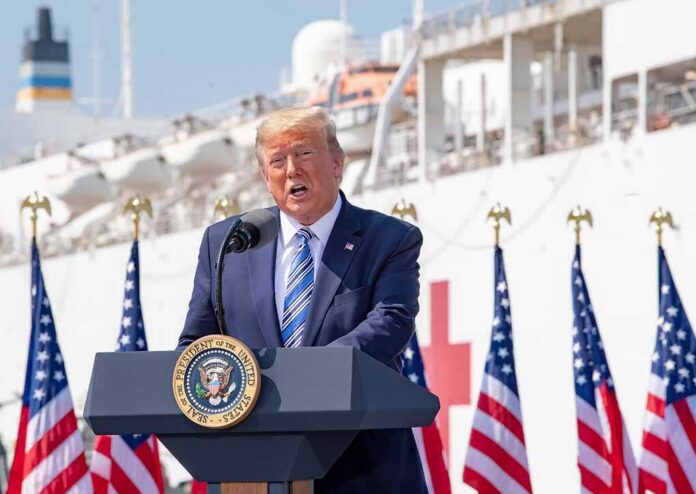
At a packed Michigan rally, President Trump labeled Abdul El-Sayed a “jihadist Muslim Brotherhood member,” drawing swift backlash and fresh questions about evidence behind the charge.
Story Snapshot
- Trump accused El-Sayed of ties to jihadists and the Muslim Brotherhood at an Oct. 25 Port Huron rally.
- News outlets reported no evidence for membership claims; El-Sayed denied any connection.
- The remarks targeted Black and Jewish voters, inflaming a close Michigan Senate race.
- El-Sayed’s pitch centers on healthcare and costs, while critics debate his Israel and Gaza stance.
What Trump Said, Where He Said It, and Why It Matters
On October 25 in Port Huron, Michigan, President Trump told thousands of supporters he aimed to stop Abdul El-Sayed from becoming a senator, calling him “a jihadist Muslim Brotherhood member.” He argued someone with a “record of support for jihadists” would not pass airport screening, and should not sit in the United States Senate. Reports placed the crowd above 4,000 and noted the Michigan Senate race remains tight, with national stakes hanging on turnout and late-breaking views.
Trump also said, “If you’re Black or if you’re Jewish, and if you vote for Abdul, you’re crazy,” tying his warning to two key voting blocs. The line sought to frame support for El-Sayed as unsafe or irrational. The comments landed in a state where both parties court Detroit’s Black voters and where debates over Israel and Gaza have strained Democratic coalitions around Jewish voters and progressives.
The Evidence Gap and El-Sayed’s Response
Major outlets covering the rally reported that Trump offered no proof that El-Sayed is a Muslim Brotherhood member. They described the allegation as unsupported and noted that El-Sayed denied any such ties. No records, witnesses, or government findings were cited that confirm the claim. That left voters weighing a grave charge against the absence of verifiable evidence during a final stretch when emotions already run high.
El-Sayed and allies argued Republicans are using fear to divide voters along religious and racial lines, pointing to a pattern of attacks on Muslim candidates. They stressed that such tactics can pull focus from policy questions central to families, like healthcare costs and wages. Analysts warned that when leaders use labels like “jihadist” without clear sourcing, it can reduce complex issues to identity fights and deepen distrust in political institutions.
Policy Stakes for Black and Jewish Voters in Michigan
El-Sayed’s campaign message highlights lower costs, better healthcare access, and housing. Supporters say these priorities match daily needs in Detroit and across the state. Canvassers cite roads, rents, and medical bills as the pressures they hear about most. One reported poll suggested El-Sayed performs relatively well among some former Trump voters on healthcare and the economy, hinting at crossover appeal on cost-of-living themes.
Outreach to Jewish voters has focused on safety and faith. El-Sayed has condemned antisemitism, said Jewish families must be able to worship without fear, and stated he condemned Hamas’s October 7 attacks. He argues people can criticize the Israeli government while “loving and revering” Judaism and Jewish people. Still, his sharp criticism of Israel’s war in Gaza and opposition to United States aid have drawn concern from some Jewish Democrats.
Security Labels, Real Organizations, and the Risk of Overreach
The Muslim Brotherhood is a real international movement with varied chapters and politics. United States debate over how to treat those chapters has intensified. Some analysts warn that broad-brush labels can sweep in people and groups with no link to violence, while making measured security screening harder. When campaigns use the term without clear, case-specific proof, voters are left to parse fear from fact in a noisy media space.
🚨WATCH: Sen. Bernie Sanders (I-VT) accuses President Trump of "waging a disgusting, racist attack against" Michigan Democratic Senate candidate Abdul El-Sayed. pic.twitter.com/57C48o1gsu
— The New England Signal (@TheNESignal) October 29, 2026
Michigan voters now face a hard test familiar to many Americans: how to judge a serious security claim when evidence is not public. Some will prioritize caution; others will reject identity-based attacks on principle. Many, across right and left, share a deeper worry that leaders stoke division instead of fixing costs, safety, and trust. That frustration will likely shape turnout more than any single rally line, unless new verified facts emerge.
Sources:
facebook.com, inquirer.com, bbc.com, nbcnews.com, newser.com, san.com, theatlantic.com, ajcongress.org, abc6onyourside.com, dawn.com, bridgemi.com, csrr.rutgers.edu