

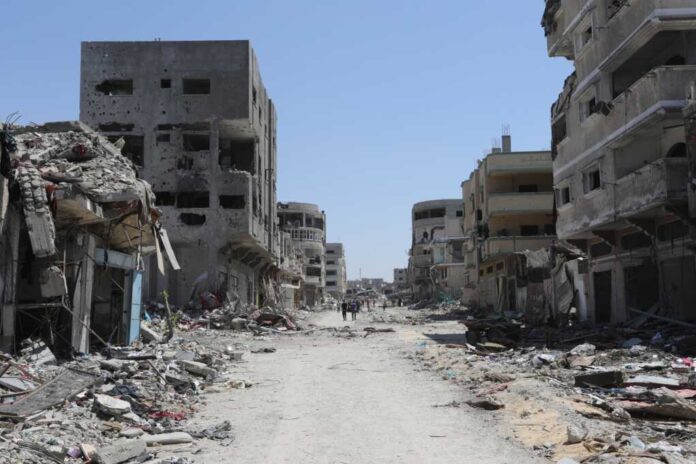
Post-conflict planning for the Gaza Strip has focused on a proposal backed by the United States that involves dividing the territory into security and reconstruction zones. The plan outlines areas to be secured by Israeli and international forces, while other areas are designated as off-limits due to devastation. This proposal has prompted debate regarding its impact on local governance and future stability in the region.
Story Highlights
- The US is supporting a proposal to partition the Gaza Strip into secure “green zones” for reconstruction and “red zones” designated as uninhabitable.
- The “green zones” would be secured by Israeli and international military forces, not US troops, as part of a post-conflict plan for Gaza.
- Reports of extensive planning and coordination were made public despite a February 2025 US Senate resolution against direct US military occupation.
- Critics express concern that the plan bypasses Palestinian governance, risks permanent division, and could undermine long-term peace prospects without local consultation.
Details of the Proposed Zone Plan
In 2025, US officials have advanced a postwar blueprint for Gaza that proposes a territorial division into designated areas. The plan centers on establishing a “green zone” intended for reconstruction and civilian resettlement. Security for this zone is slated to be provided by Israeli and international forces. Other areas, referred to as “red zones,” are reportedly to remain restricted and uninhabitable due to the extent of destruction. This concept recalls the “Green Zone” established in Baghdad following the Iraq War.
Washington has issued public statements that explicitly rule out a direct US military occupation of Gaza. In February 2025, the US Senate passed S.Res.68, which clarified that American forces would not “take over” the territory. However, recent reports indicate substantial American participation in developing the zone plan and coordinating with allied nations. The reliance on Israeli and international forces for security, as opposed to the US military, is seen by some as an effort to mitigate concerns about foreign involvement, but the American role in the planning process remains a key point of discussion.
US military planning for divided Gaza with ‘green zone’ secured by international and Israeli troops | Gaza | The Guardian https://t.co/vdtF4cuFAb
— Leo Chapel (@chapel_leo) November 15, 2025
Concerns Over Palestinian Governance and Local Input
A primary critique of the arrangement is the limited participation of Palestinian representatives in the planning process, which is reportedly dominated by US and Israeli officials. While a minor administrative function may be offered to the Palestinian Authority, its influence in Gaza is noted as limited, and local factions such as Hamas are reportedly excluded from negotiations. This dynamic has led to concerns that the future of Gaza is being determined primarily by external powers, with regional actors like Egypt and Jordan expected to support order-keeping efforts. The absence of broad Palestinian consultation is cited by observers as a potential factor for future resentment and instability.
In the short term, the creation of controlled “green zones” may facilitate some humanitarian aid and basic reconstruction efforts. However, displaced residents face uncertainty regarding the restoration of property rights and the feasibility of returning home, as significant portions of Gaza are designated as “red zones.” Local civil society groups have reportedly been marginalized, raising concerns that the security arrangements could deepen divisions and compromise prospects for lasting self-governance or peace.
International Security Precedents and Challenges
Proponents of the plan have drawn comparisons to the “Green Zone” in Baghdad as a model for reestablishing order after conflict. However, that precedent also demonstrated that security achievements implemented by external forces can generate local opposition and raise questions of legitimacy. In Gaza, the planned involvement of Israeli forces in security operations is a particularly sensitive aspect given existing tensions.
The specific mandate and composition of the proposed international security force are still subject to ongoing negotiations and disagreement among stakeholders regarding the path forward.
Ongoing Deliberations and Future Uncertainty
While the US administration asserts that the plan is intended to promote reconstruction and stability, other parties warn that it may instead exacerbate existing issues. By confining reconstruction to “green zones” and placing a security regime over the remaining territory, critics argue the blueprint risks creating permanent divisions and potentially fueling further conflict. International non-governmental organizations and Palestinian leaders have formally objected to the limited local input. Meanwhile, Israeli officials have insisted on robust security guarantees before permitting any resettlement. As the United Nations Security Council is scheduled to debate various proposals, the future structure of Gaza remains a key international issue.
Watch the report: Gaza Plan: Reconstruction For Israeli-Controlled Zone? | WION Pulse
Sources
US military planning for divided Gaza with ‘green zone’ secured by international and Israeli troops
US revises post-war Gaza plan, considering division into green and red zones (map) | in-cyprus.com
US outlines plan for a divided Gaza under Israeli, foreign troop control