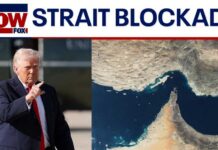

Iran’s own incompetence has trapped its mines in the Strait of Hormuz, handing President Trump powerful leverage to force free navigation through the world’s critical oil chokepoint.
Story Highlights
- U.S. officials reveal Iran lost track of naval mines deployed haphazardly via small boats, blocking full reopening of the Strait.
- President Trump demands complete, immediate, and safe opening as a precondition for negotiations, exposing Iran’s self-inflicted weakness.
- Ships forced into Iranian waters under a $2 million toll scheme, raising costs and risks for global oil trade.
- Neither side possesses adequate minesweeping assets, stalling talks and sustaining U.S. strategic advantage.
- Strait carries 20% of global oil, making Iran’s disarray a boon for America’s energy security and economic pressure tactics.
Iran’s Decentralized Mining Backfires
U.S. intelligence assesses that Iran deployed approximately a dozen advanced Mahan 3 moored/acoustic mines and Maham 7 bottom/influence mines using small boats during recent escalation. These operations lacked a clear command chain, with 2-3 mines per craft dropped without precise records. Small boat dispersal prevented centralized tracking, allowing some mines to drift. This haphazard approach, confirmed by anonymous U.S. officials, now prevents Iran from locating all devices, directly complicating efforts to reopen the 21-mile-wide Strait of Hormuz.
Trump’s Firm Demands Seize the Advantage
President Donald Trump stated on Tuesday that the United States requires the “complete, immediate, and safe opening” of the Strait as a negotiation precondition. U.S. strikes, over 90 precision attacks on Kharg Island mine facilities overseen by Adm. Brad Cooper of CENTCOM, degraded Iran’s capabilities beforehand. Iran’s response—deploying mines amid ceasefire threats—created its own barrier. This irony positions Trump advantageously, as Iran’s disorganization undermines its threats while validating America’s hardline America First posture against foreign aggression.
Negotiations in Islamabad, led by U.S. Vice President JD Vance, face this core impasse. Iran claims the Strait reopened and shared mine data, but U.S. intel disputes this, noting persistent hazards from the dozen mines. Traffic trickles through an Iranian-controlled lane between Qeshm and Larak islands, requiring approval and tolls for “non-hostile” ships.
Economic Leverage and Global Risks
The Strait handles 20% of global oil consumption, making disruptions a potent weapon, yet Iran’s poor execution yields outsized U.S. benefits. Ships detour into risky Iranian waters, facing a proposed $2 million toll per transit, heightening collision and mine risks. Neither the U.S. nor Iran has local minesweeping tools—America’s Avenger-class vessels decommissioned, LCS platforms distant—necessitating threat reduction before clearance operations.
Iran Can’t Fully Reopen Strait Because It Forgot Where It Placed Mines, U.S. Officials Claim #Mediaite https://t.co/g61eAlNiH4
— #TuckFrump (@realTuckFrumper) April 11, 2026
Short-term, maritime insurance surges and shipping slows to a trickle, with no new attacks but persistent drone and rocket threats. Long-term, prolonged hazards could spike energy prices, hurting global consumers while reinforcing the need for domestic fossil fuel reliance over unreliable foreign chokepoints. This episode underscores elite mismanagement abroad, mirroring frustrations with federal overreach at home, where both conservatives and liberals decry government failures blocking the American Dream.
Sources:
US says Iran lost track of mine locations spread in Strait of Hormuz, complicating reopening – NYT
Amid Iran talks, Strait of Hormuz dotted with about a dozen Iranian mines
Report: Two Types of Iranian Mines Detected in Strait of Hormuz
Strait of Hormuz – Mines – The Strauss Center
Five Things to Know About Iranian Minelaying