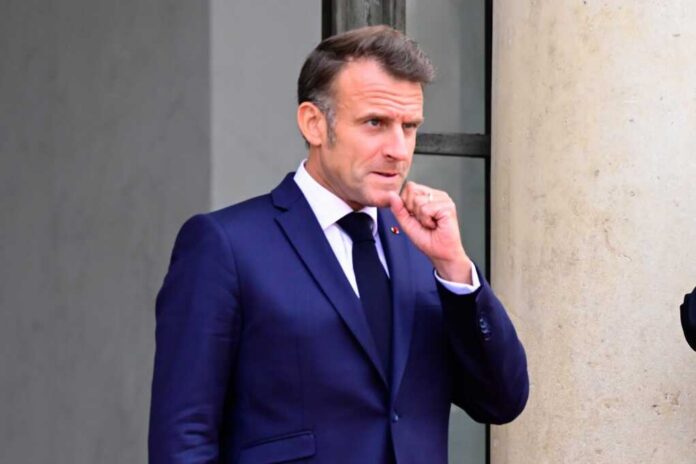
French President Emmanuel Macron’s latest push for deeper European integration reveals a globalist agenda that threatens national sovereignty and could bind European nations into an even more bureaucratic superstate—despite misleading claims he wants to dismantle the EU.
Story Snapshot
- Macron advocates for deeper EU integration through common debt, capital market union, and regulatory centralization—not dissolution
- His three-pillar reform strategy pushes “European preference” trade protectionism, regulatory simplification, and single market expansion
- Proposals include €1.2 trillion annual investment targets funded by future-oriented Eurobonds and pooled European debt
- Reform agenda threatens member state autonomy while channeling €30 trillion in European savings toward centralized EU investment schemes
Macron’s Globalist Vision: More EU, Not Less
Emmanuel Macron delivered a special address at the World Economic Forum in February 2026 outlining an ambitious reform agenda that doubles down on European integration, directly contradicting claims he seeks to break up the EU. His three-pillar strategy focuses on protection through “European preference” trade policies, simplification by eliminating regulations across automotive, chemicals, digital, AI, and banking sectors, and growth by deepening the single market for 450 million Europeans. This represents classic globalist centralization—concentrating power in Brussels rather than respecting individual nation sovereignty.
Common Debt Schemes Threaten Fiscal Sovereignty
Macron’s call for “future-oriented Eurobonds” and common European debt mechanisms reveals the dangerous fiscal consolidation at the heart of his agenda. He proposes channeling Europe’s €30 trillion in savings toward centralized EU investments in defense, AI, quantum technologies, semiconductors, and green-digital transition projects—requiring approximately €1.2 trillion annually in public and private investment. This debt-sharing scheme forces fiscally responsible nations to backstop spending decisions made by unelected Brussels bureaucrats. Americans watching the federal government’s reckless spending understand exactly where this road leads: inflation, loss of control, and taxpayers footing the bill for others’ priorities.
Capital Market Union: Centralizing Financial Control
The proposed Capital Market Union represents another power grab, redirecting European savings from external markets toward internal innovation and equity investment under EU oversight. Macron has consistently pushed integrated capital markets, Europe-wide deposit insurance schemes, and fiscal union mechanisms since his 2017 Sorbonne speech. His frustration with German leaders like Angela Merkel and Olaf Scholz for resisting these proposals demonstrates that many Europeans recognize the sovereignty threat. Working with European Commission President Ursula von der Leyen, Macron successfully pushed through a €750 billion COVID-19 recovery plan in July 2020—proving his ability to consolidate power during crises. The pattern mirrors how Washington expanded federal authority at state expense.
MACRON: HE WANTS TO BREAK UP THE EU! https://t.co/8ep1MUC9rl
— NA404ERROR (@Too_Much_Rum) February 10, 2026
Strategic Autonomy or Protectionist Overreach
Macron frames his agenda as achieving “strategic autonomy” from U.S. and Chinese influence through protective measures against American tariffs and import controls. While reducing dependency on China makes sense, his “European preference” policies create protectionist barriers that could spark trade tensions with the United States under President Trump’s administration. The timing reflects geopolitical pressures from transatlantic strains, Russian hybrid threats, and Chinese economic dominance—legitimate concerns that Macron exploits to justify centralizing authority. His omnibus simplification package coordinated with the European Commission may reduce some compliance costs for businesses, but regulatory power transferred to Brussels rarely benefits citizens or respects local control. The fundamental question remains: who decides Europe’s future—elected national governments accountable to their people, or globalist technocrats in Brussels pushing integration regardless of public sentiment?
Sources:
Davos 2026 Special Address – Emmanuel Macron
Can Macron Still Persuade Europe to Reform?
Macron Put His Helmet On With Call for EU Common Debt
European Parliament Briefing – February 2026 EU Leaders’ Retreat