
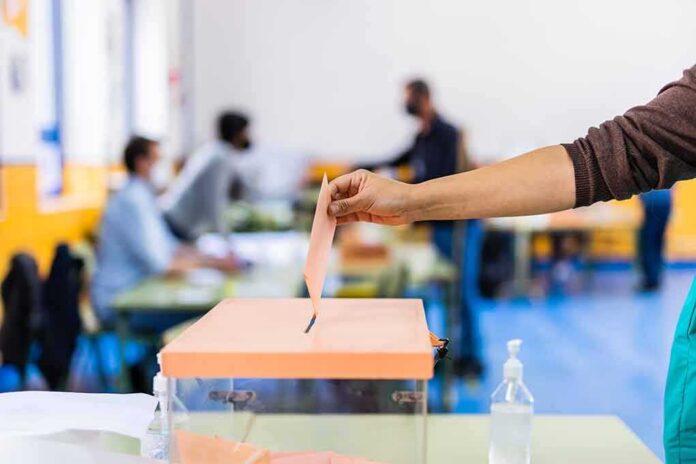
A record wave of early votes is flooding key states, threatening to upend polling models that assume a routine midterm turnout.
Story Highlights
- Early voting has surged in several states, raising doubts about standard turnout assumptions.
- Ohio’s data gaps make it hard to judge which party benefits from the surge.
- Some polls in Ohio show a tied race, underscoring real uncertainty.
- Experts say early votes show participation, not winners, and may shift timing, not totals.
Early-Vote Surges Challenge Old Turnout Assumptions
Associated Press reporting says early voting jumped seventy four percent in Texas and rose more than thirty percent in Ohio, North Carolina, and Maine, compared with the same point in 2022. Those are big shifts for a midterm year. Large early totals raise the stakes for how pollsters guess who will actually vote. A forecast built on last cycle’s patterns can miss when the mix of voters changes in real time. That is why this surge matters for reading polls.
Separate tallies cited more than forty one million early ballots nationwide at one stage. Texas neared more than seventy percent of its 2022 total turnout in early votes alone. Georgia passed two million early ballots, and Ohio topped one million. High participation does not pick a side by itself, but it does change the math. Models about age, region, and voting method can swing results when the voter pool shifts this much before Election Day.
Ohio’s Data Gaps Leave Partisan Effects Unclear
The New York Times reports that Ohio does not register voters by party, and counties only standardized some absentee fields in 2023. Not all counties publish voting method results. That means analysts cannot cleanly tag early ballots as Republican or Democratic. Campaigns and media still try to infer lean by county or past primary history, but those proxies can mislead. Until the votes are counted, claims about which side gains most from early turnout in Ohio remain uncertain.
This uncertainty meets mixed polling. One survey of likely voters showed Senator Sherrod Brown and Lieutenant Governor Jon Husted tied at forty seven percent, with a margin of error of plus or minus five point two points. A tie within that range means the race could tilt either way. Republican officials also stress turnout as the key to winning close contests. When early participation spikes and the polls are tight, final results can break against pre-election narratives.
Poll Methods Evolve, But Assumptions Still Matter
Major outlets describe likely-voter screens that blend past voting records with stated intent to vote. Pollsters also use probability-based panels, voter-file samples, mixed survey modes, and tighter weighting to fix gaps. These steps are meant to prevent misses like those seen in past cycles. But even strong methods rely on turnout assumptions. If who shows up shifts late, or the early vote changes the mix, a sound model can still land off by a few points.
Experts warn that early voting totals show when people vote, not who they support. Many early voters would have voted on Election Day anyway, so part of the surge may be timing, not new turnout. In some states that track registration, early ballots have leaned Democratic. In others, the picture is mixed. The safest read is this: heavy early participation makes the composition of the electorate the central variable, and small errors in that guess can swing close races.
Why This Matters Beyond the Horse Race
Voters across the spectrum worry that powerful insiders set the story before the facts are in. When media or campaigns frame early votes as proof of one party’s edge, trust takes a hit if results differ. Clear limits on the data can keep expectations honest. Ohio’s opaque files and fast-rising early turnout show why patience matters. Counting will settle who benefited. Until then, polls are guides, not guarantees, and turnout assumptions—not candidate speeches—may decide the miss.
Sources:
pjmedia.com, kmbc.com, whio.com, english.elpais.com, spectrumlocalnews.com, rmb.reuters.com, palmbeachpost.com, pewresearch.org