
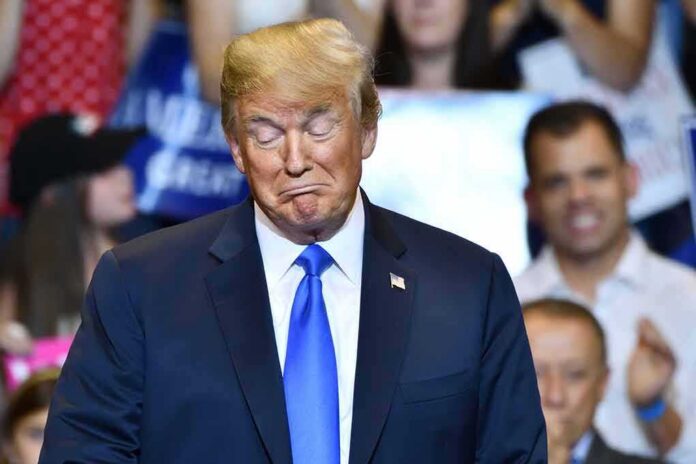
Standing in China before meeting Xi Jinping, President Trump openly said the United States spies on China—and claimed “we spy better,” a blunt message with real diplomatic and security stakes.
Story Snapshot
- Trump said “We spy on China. They spy on us,” and added “I think we spy better than they do.”
- The remarks came in Shenzhen ahead of planned talks involving China’s Xi Jinping.
- Multiple outlets reported the same quotes, confirming the public statement.
- Experts say proving “spying better” is not possible with public evidence.
What Trump Said, Where He Said It, and Why It Matters
President Trump told reporters in Shenzhen that the United States and China spy on each other. He added that he believes the United States does it better. The comments came just before planned talks with Chinese President Xi Jinping. CNN published video of the line “We spy on China, they spy on us,” and cited the “spy better” claim, confirming that the exact words were said on camera. The timing and location gave the remarks extra weight.
Other outlets repeated the same quotes, which supports that the words were not a one-off misheard line. TRT World reported the “spy on each other” and “upper hand” framing. PrimeTimer also cited “I think we spy better than they do.” This broader repeat across outlets means the public record for the quotes is solid. It does not, however, prove the truth of the comparison. It only proves that Trump made the claim publicly.
What Is Established Fact Versus Unproven Assertion
The fact is clear: Trump acknowledged two-way spying and said the United States is better at it. That is on video and in print. What is not proven is the comparison itself. Intelligence performance is secret, complex, and split into many areas like human sources, cyber, satellites, and signals. Public records cannot grade those parts like a scorecard. Even when outcomes surface, the most important details stay classified. That is why this kind of claim is hard to confirm in public.
Open reporting in cyber suggests caution on broad “we are better” talk. The Council on Foreign Relations wrote that United States offensive cyber work has disrupted some Chinese efforts but has not cut China’s overall capacity or stopped major campaigns at scale. That view does not settle the full spying debate, but it does challenge a blanket edge claim in at least one key domain. Cyber is only part of intelligence, yet it is a large and visible part.
Diplomatic and Security Stakes Around Saying the Quiet Part Out Loud
Publicly stating that spying is mutual can land differently inside a summit. Chinese leaders already assume it; so do American leaders. The risk is that saying it on camera can push both sides to react. It can raise scrutiny on diplomats, business travelers, and local staff. It can drive new countermeasures, which makes intelligence work harder and more costly. It can also become a bargaining chip that crowds out topics like trade or fentanyl flows.
Public comments about secret work can also feed rival storylines. Supporters may hear strength and honesty. Critics may hear careless bragging. Both views can live online faster than facts can catch up. When governments cannot share proof without exposing sources and methods, silence feels like spin. That leaves regular people stuck between bold claims and thin public evidence, which deepens the sense that the “elites” keep the real story to themselves.
How Both Left and Right Will Read This—and What Citizens Should Watch Next
Many conservatives will cheer a clear message that the United States plays to win. They want tough talk after years of theft of technology and cyber hits. Many liberals will worry that loose words raise risks for Americans abroad and for partners who help the United States. Both sides share one core concern: Washington often talks big, then hides the scorecard. People want proof that leaders are improving security, not just scoring points on television.
Watch three things next. First, listen for any shift in China’s tone or security steps after the summit, such as tighter travel rules or public probes. Second, look for United States actions that match the rhetoric, like new cases by the Federal Bureau of Investigation, sanctions, or visible cyber defenses. Third, track whether the White House or intelligence leaders offer a careful follow-up that clarifies the goal of the remarks without exposing sources or methods.
Bottom Line
Trump’s on-camera line made the private reality of great-power spying public and political. The record shows he said it; it does not show that the United States “spies better” across the board. Cyber evidence in open sources points to a mixed picture. The risk is that words meant to project strength can also raise costs and confusion. The test is whether policy and results—seen in safer systems, fairer trade, and fewer breaches—follow the headline claim.
Sources:
thegatewaypundit.com, primetimer.com, x.com