AOC’s shaky answers at a major security conference handed America’s critics fresh ammunition—and raised a basic question about whether Democrats are prepared for serious foreign-policy decisions.
Quick Take
- Rep. Alexandria Ocasio-Cortez drew widespread criticism after appearing at the 62nd Munich Security Conference.
- Reports focused on moments where she appeared to struggle with questions on Taiwan and Venezuela—two flashpoints that demand clarity.
- AOC also delivered a broader message promoting a “working people” foreign-policy framework and defending a rules-based international order.
- Criticism came from the right and beyond typical partisan circles, including a Catholic bishop cited in coverage.
Munich Spotlight Puts AOC’s Foreign-Policy Readiness Under a Microscope
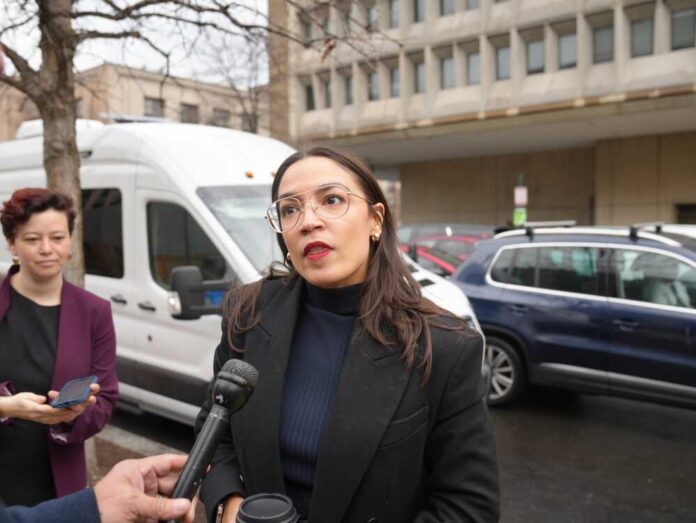
Rep. Alexandria Ocasio-Cortez (D-NY) traveled to the 62nd Munich Security Conference, a high-profile forum where U.S. officials and global leaders discuss war, deterrence, alliances, and strategic threats. Her appearance quickly became a domestic political story after coverage and clips highlighted what critics described as verbal stumbles and unclear answers during Q&A. The most repeated complaints centered on Taiwan and Venezuela, issues where vague messaging can create diplomatic confusion.
The criticism matters because Munich is not a campus debate stage; it is where allies look for signals and adversaries watch for hesitation. When a member of Congress appears uncertain in a public forum about core questions—such as what level of support the United States should provide to a threatened partner—those remarks can be amplified far beyond U.S. cable news. Available reporting says she “stumbled over her words” on Taiwan and did not clearly commit to defending the island.
Taiwan and Venezuela: Why Precision Beats Slogans in Real-Time Diplomacy
Taiwan sits at the center of a long-running strategic contest with China, and public statements by U.S. officials can affect deterrence calculations. That is why critics seized on reports that AOC’s response sounded evasive or noncommittal. Venezuela, meanwhile, remains a contentious subject involving human rights concerns, regional stability, and competing narratives about U.S. influence. Coverage also reported backlash tied to her Venezuela remarks, including criticism referenced from Catholic leadership, indicating the blowback was not confined to partisan opponents.
The research material also highlights a key limitation: the available sources emphasize headlines and selective moments rather than comprehensive expert review of her full performance. That means the sharpest “train wreck” characterizations are better understood as political framing rather than neutral evaluation. Still, the underlying issue conservatives will focus on is straightforward: foreign policy is not forgiving, and leaders are judged on clarity, discipline, and command of details—especially when the subject is deterrence and national security.
What AOC Actually Said: Rules-Based Order, “Hypocrisy,” and Tech Regulation
AOC did not only field tough questions; she also presented a broader worldview. In her remarks, she argued many Americans are not ready to abandon a rules-based international order and suggested U.S. “hypocrisy” can be a vulnerability in global affairs. She also warned against a posture that would withdraw America from the world, describing that outcome as enabling authoritarian consolidation of power. In addition, she pointed to European-style technology rules—such as the DMA and DSA—as models for algorithm-related concerns.
Those themes reflect a distinctly progressive approach: skepticism about American power, heightened emphasis on narratives and domestic class politics, and interest in importing European regulatory concepts. Conservatives generally see a different priority set: peace through strength, deterrence grounded in credible commitments, and restraint on bureaucratic regulation that can threaten free speech and innovation. From the research provided, the bigger takeaway is not that AOC lacked talking points—it is that critics argue her delivery and specificity failed under pressure.
Political Fallout: A Bipartisan-Looking Pile-On and a Messaging Problem for Democrats
Political reaction accelerated after commentators circulated clips and summaries, including criticism from Greg Gutfeld and others who portrayed Democrats as unserious on the world stage. One report also noted criticism spanning from GOP voices to a Catholic bishop, signaling a broader reputational hit than the usual partisan back-and-forth. Even if supporters view her comments as nuanced, the political cost comes when nuance reads as indecision—especially on questions that demand a plain answer.
Democrats have tried to broaden their bench on national security, but this episode shows how quickly the conversation can turn to competence and credibility. In 2026, with President Trump back in office and the Biden era over, the political environment is less tolerant of globalist messaging, vague commitments, or Washington-speak that sounds detached from concrete American interests. The Munich coverage gave conservatives an easy contrast: strong, direct deterrence versus progressive rhetoric that critics say collapses in real time.
Gutfeld Says Democrats Look Like ‘Children’ on the World Stage After AOC’s Embarrassing Munich Showing
https://t.co/nrsAkXt8ro— Townhall Updates (@TownhallUpdates) February 18, 2026
AOC’s office and allies may argue that critics cherry-picked clips or that her core points were misrepresented. The research, however, notes gaps that prevent a fully settled verdict—especially about the full context of her Taiwan exchange and the specifics of what triggered the Venezuela backlash. Until more detailed transcripts and independent analysis are widely examined, the safest conclusion is limited but important: her appearance became a story because public-facing clarity faltered on issues where America’s allies and adversaries demand clarity most.
Sources:
AOC mocked for “absolute train wreck” weekend on global stage made fool out of herself
Critics pile on after AOC’s Munich remarks, from GOP to a Catholic bishop
Crow, Ocasio-Cortez Advance Alternate Foreign Policy Vision for Working People at Munich Security Conference