

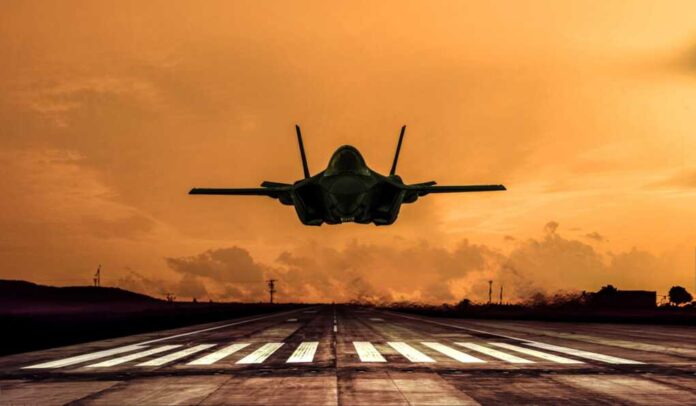
The F-15EX Eagle II’s portrayal as a “flying supercomputer” is under scrutiny, challenging its supposed status over the F-35.
Story Highlights
- The F-15EX Eagle II is marketed as having superior computational power, but specifics remain unverified.
- The aircraft is designed to complement, not replace, the F-35, focusing on payload and non-stealth roles.
- Key improvements include an advanced radar system and open-mission software.
- Deployment in strategic locations like Japan highlights its importance in US defense strategy.
F-15EX Eagle II: More Than Just Numbers?
The F-15EX Eagle II has been touted as a “flying supercomputer,” supposedly capable of performing 87 billion operations per second. This claim has circulated widely, yet lacks substantiation from credible technical sources. Instead, the F-15EX stands out for its robust payload capacity and advanced avionics, including the Active Electronically Scanned Array (AESA) radar and open-mission systems, which are vital for its role as a missile truck rather than a stealth aircraft.
Development of the F-15EX comes as the U.S. Air Force seeks a reliable and cost-effective solution to replace its aging F-15C/D fleet. Originally derived from the F-15QA, the Eagle II is equipped with state-of-the-art technology to ensure dominance in air superiority. Efforts to integrate advanced weaponry like hypersonic missiles and infrared search and track systems further enhance its combat capabilities, making it a formidable force in the current geopolitical climate.
Strategic Deployments and Operational Readiness
The F-15EX has been strategically deployed to Kadena Air Base in Japan, marking a significant step in U.S. defense operations in the Indo-Pacific region. This deployment underscores the aircraft’s role in maintaining regional stability and countering potential threats from adversarial nations. With 36 units stationed at Kadena, the Eagle II enhances the U.S. military’s ability to project power and ensure readiness in a critical area of operations.
Despite production delays, the F-15EX program continues to advance, with over 20 units delivered and operational. The open-mission systems architecture allows for rapid updates, ensuring the aircraft remains adaptable to emerging threats and technological advancements. Such flexibility is crucial as the Air Force navigates a dynamic global security environment.
Economic and Political Implications
The F-15EX program not only strengthens the U.S. Air Force but also bolsters the domestic defense industry, supporting thousands of jobs and generating significant economic activity. Politically, the aircraft represents a shift towards a more balanced fleet that combines the strengths of both stealth and non-stealth platforms. This approach addresses the limitations of a “fifth-generation only” strategy, providing a versatile and resilient military capability for the future.
Forget the F-35: At 87 Billion Operations Per Second, the F-15EX Eagle II Is a Flying Supercomputerhttps://t.co/DNDbEKIp7O
— Harry Kazianis (@GrecianFormula) January 23, 2026
The F-15EX’s development and deployment reflect a pragmatic approach to modern defense challenges, ensuring that the U.S. remains a step ahead of its adversaries. As the program progresses, it will likely continue to influence defense policy and military strategy in the years to come.
Sources:
Air & Space Forces Magazine – Weapons: F-15EX
Army Recognition – Military Products: F-15EX Eagle II
Wikipedia – Boeing F-15EX Eagle II
The National Interest – F-15EX Eagle II Fighter Resumes Production