
Explosions, drone interceptions, and fires around a U.S. base in northern Iraq are once again showing how a distant war between Washington and Tehran can endanger Americans on the ground while raising hard questions about who is really keeping this country safe.
Story Snapshot
- Multiple explosions shook areas near the U.S. consulate and air base in Erbil, Iraq, as air defense systems fired on incoming drones and missiles.
- Regional security officials say U.S.-led forces intercepted several “suicide” or explosive drones targeting the base, but full damage and casualty reports are still unclear.
- Iran and Iran‑backed militias publicly claim strikes on U.S. facilities in Iraq, tying the Erbil attacks to a wider campaign across the Middle East.
- The incident fits a growing pattern: U.S. bases abroad under regular fire, messy information, and Americans left wondering whether endless foreign conflict is making them safer or more vulnerable.
Explosions and Drone Interceptions Around the Erbil Base
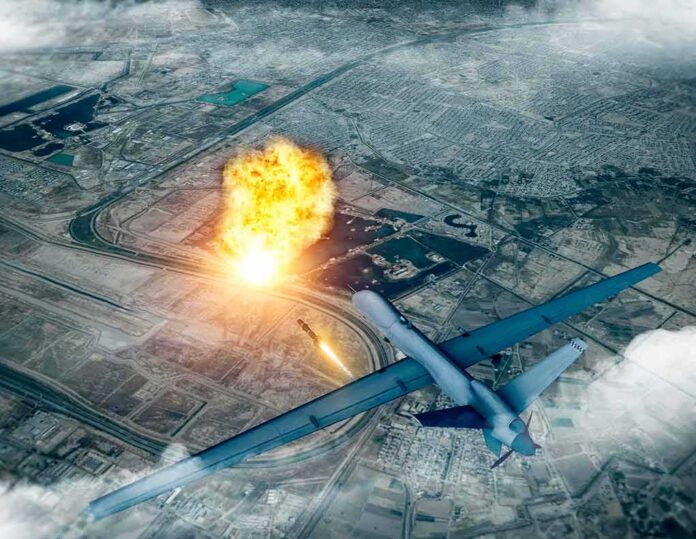
AFP reporters and local media describe a tense scene in Erbil, the capital of Iraq’s Kurdish region, as loud blasts echoed near the U.S. consulate and the airport that hosts American troops. Journalists near Erbil Air Base reported air defense systems firing at incoming projectiles, though early reports could not clearly say if they were drones or missiles. Kurdish regional security officials later said coalition forces intercepted and destroyed several drones and missiles over Erbil province, confirming that this was not a false alarm.
Regional outlets add more detail, saying “suicide” or explosive‑laden drones tried to hit the U.S. base by the airport, triggering multiple explosions as defenses opened fire. A report citing Turkish agency Anadolu says air defenses around Erbil International Airport activated as unmanned aircraft approached, and successfully neutralized them before impact, while other footage shows flames and smoke rising near U.S. facilities. This mix of interception and visible fire suggests that at least some drones were shot down in the area, while others may have reached ammunition or fuel sites and set off secondary blasts.
Claims of Responsibility and the US–Iran Showdown
Iran’s government has publicly said it struck U.S. bases in Iraq’s Kurdistan region as part of a broader campaign that also targets locations in Bahrain, Jordan, Kuwait, and Israel. At the same time, Iran‑aligned militias in Iraq, grouped under the name Islamic Resistance, claim they attacked American bases in Irbil with drones and rockets in revenge for U.S. and Israeli strikes that killed Iranian Supreme Leader Ali Khamenei. Another armed group, Saraya Awliya Al Dam, says its drones hit an ammunition depot near Erbil International Airport, which hosts U.S. forces, leading to a major fire.
These claims matter because they show how the Erbil incident is not random violence but part of a tit‑for‑tat cycle between Washington and Tehran that has been growing for years. In 2021, rockets already struck the coalition base near Erbil airport, killing two people and injuring thirteen more, including an American service member. Today’s drone and missile threats follow the same pattern, only now with more advanced unmanned systems that are harder to track and can be launched by small militias, not just state armies. Both conservatives and liberals at home see this as proof that America’s enemies feel bold, while our leaders stay locked in old wars that never seem to end.
Fog of War, Missing Facts, and Rising Public Distrust
Despite the dramatic video and satellite images, key facts remain murky: Iraqi and U.S. officials have yet to issue a full after‑action report, and there is still no clear public tally of casualties or damage inside the base. Several reports stress that it is “unclear” whether specific blasts were caused by direct hits or by anti‑aircraft interceptions overhead, and that some accounts rely on unnamed security sources. This is common in Iraq: when drones or rockets strike near U.S. facilities, the first information usually comes from witnesses, local outlets, and militias bragging online, not from verified radar data or debris studies.
🇮🇷💥🇺🇸🇮🇶Satellite images show that the US Patriot air defense system in Erbil was targeted early this morning
Indications of possible damage to its deployment site are visible; several areas of fire were observed around the base, likely caused by secondary explosions. pic.twitter.com/nawHVYzpBP
— Hawkeye1812Z (@Hawkeye1745) July 24, 2026
For many Americans watching from home, that confusion feeds a deeper worry. People on the right see endless foreign missions, interceptor stockpiles running low, and bases under fire, yet they hear more from media pundits than from the Pentagon about how these attacks are being stopped. People on the left see U.S. troops hit in places most citizens cannot find on a map and ask whether America First or any other slogan has really changed a foreign policy that still puts soldiers, not elites, in harm’s way. When the government does not quickly explain what happened, both sides suspect the same thing: the system protects itself first and tells the public only what it must.
What This Means for US Power and Ordinary Citizens
This latest strike near Erbil shows how vulnerable U.S. forces can be, even at heavily guarded sites far from any declared front line. Drone warfare makes it cheap and easy for small groups to threaten billion‑dollar bases and high‑tech systems like Patriot and C‑RAM, and every interception uses up more ammunition and money without ending the conflict. Meanwhile, Americans at home live with aging infrastructure, high costs, and political gridlock, while watching footage of their tax dollars exploding in foreign skies night after night.
These events also highlight a simple, troubling truth: neither party’s leaders have offered a clear path out of this cycle, even as both voters grow more skeptical of overseas wars and the “deep state” that manages them. Conservatives see proof that globalist strategies and endless deployments have stretched U.S. power thin; liberals see proof that military answers alone cannot fix the widening gap between ordinary people and the elites who choose these fights. What happened near the U.S. base in Erbil is not just another headline from far away. It is another warning flare showing how a distant drone war can expose American weakness abroad and deepen mistrust of government at home.
Sources:
military.com, en.yenisafak.com, youtube.com, aljazeera.com, caspianpost.com, timesofisrael.com, cnn.com, thenationalnews.com, facebook.com, aa.com.tr