

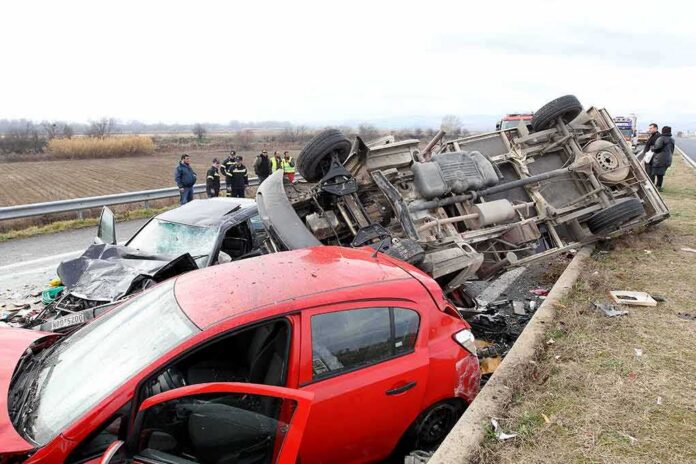
A 21-year-old college hockey captain died after a wrong-way driver hit his car head-on on Interstate 91 in Connecticut, triggering a multi-vehicle crash.
Story Snapshot
- Police say a northbound wrong-way car on I-91 South caused a deadly head-on crash.
- Ryan O’Shea, 21, a University of New Haven hockey captain, died at the scene.
- Two more SUVs then struck O’Shea’s car, and four other people were hurt.
- Officials have not released toxicology or full reconstruction details yet.
What Police Reported About The Crash Sequence
Connecticut State Police said the crash happened near Exit 9 on Interstate 91 South around 11:43 p.m. They reported a car was going north in the southbound lanes when it struck Ryan O’Shea’s Honda Accord head-on. The impact pushed O’Shea’s car into another lane, where an SUV hit it. The Honda then moved toward the right lane and shoulder, where another SUV struck it, creating a four-vehicle pileup consistent with a severe wrong-way collision.
Police and area news outlets reported one death and four injuries from the chain of crashes. The wrong-way driver’s exact age differed in coverage, with reports listing 30 or 31, while officials have not detailed how the driver entered the highway in the wrong direction. Authorities have not released toxicology results or a finalized reconstruction, which would explain impairment, speeds, and lane positions.
Who Ryan O’Shea Was To His Community
The University of New Haven confirmed that Ryan O’Shea, class of 2027, studied criminal justice and served as captain of the men’s ice hockey club team. The school said he died after being struck by a wrong-way driver on Interstate 91 South in North Haven, and it shared condolences with his family, teammates, and friends. The State Office of the Chief Medical Examiner listed his cause of death as blunt impact injuries to the head, neck, torso, and limbs, matching the high-force nature of the crash.
Local reporting described a tight-knit response, with classmates and staff honoring O’Shea’s leadership and character. That public grief reflects how rare but violent wrong-way crashes can tear through a community in a single night. The victim’s youth and campus role make the loss more visible, but the essential fact is the same for any family: a loved one did not make it home because a driver traveled the wrong way and hit head-on.
Why Wrong-Way Crashes Are So Often Deadly
Federal and state transportation records show wrong-way crashes are uncommon but unusually lethal due to head-on, high-speed impacts. Federal Highway Administration data recorded 445 wrong-way deaths in 2018 and 704 in 2022, even as overall traffic deaths also rose. The National Transportation Safety Board found that alcohol impairment is a leading factor, present in about 60 percent of fatal wrong-way crashes, though missing blood alcohol data likely hides some cases.
Connecticut has deployed ramp alerts and other steps to cut wrong-way crashes. State transportation officials report sharp drops from a 2022 spike of 13 wrong-way crashes with 23 deaths to lower totals in subsequent years, based on preliminary counts. Those tools help warn drivers before they enter a highway in the wrong direction. Still, engineering cannot catch every case, which is why enforcement, sober driving, and quick 911 reports remain key parts of prevention.
Accountability, Next Steps, And The Public’s Interest
Investigators will use crash reconstruction, medical records, and roadside evidence to establish causation. Connecticut State Police have not yet released the full report, including toxicology findings or the point where the wrong-way driver entered Interstate 91. Those details matter for any criminal review and for civil claims that could follow. They also guide roadway changes, police patrols, and public alerts that can lower the odds of the next head-on crash.
Sources:
facebook.com, newhaven.edu, whmi.com, wtnh.com, people.com, nbcnewyork.com, ntsb.gov, dot.ca.gov, highways.dot.gov