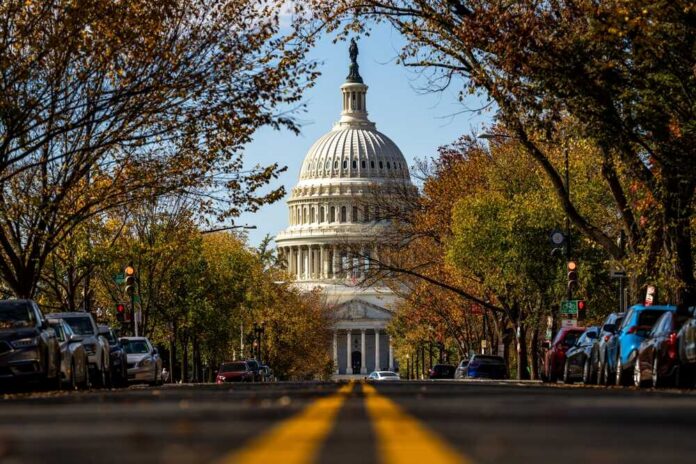
For the first time, a Republican‑controlled House has voted to curb a Republican president’s power to wage war on Iran, exposing just how far Washington’s permanent war machine has drifted from the Constitution.
Story Snapshot
- The House passed a war powers resolution 215–208 to block President Trump from ordering further strikes on Iran without Congress.[1][2]
- At least four Republicans joined Democrats, signaling rare bipartisan concern over unchecked executive war powers.[1][2]
- Proponents say the measure would terminate the use of force against Iran unless Congress explicitly authorizes it.[3]
- The vote will not immediately stop the war, underscoring how often Congress’ war‑powers “checks” become largely symbolic.[1]
House Revolt Tests Limits on Presidential War Powers
The United States House of Representatives voted 215 to 208 to approve a war powers resolution aimed at halting further military action against Iran without explicit congressional authorization.[1][2] CBS News reported that the measure is designed to block President Donald Trump from ordering additional strikes in the ongoing Iran conflict, marking the first time this House has successfully passed such a resolution on Iran.[1][2] The vote came after roughly three months of hostilities, including repeated strikes that many lawmakers argued never received a clear declaration of war.[1]
Representative Shontel Brown described the resolution as directing the president “to terminate the use of force against Iran unless explicitly authorized by Congress,” framing it squarely as an assertion of Congress’s Article I authority over war.[3] The measure was brought under the federal War Powers Resolution, a 1973 law intended to force presidents to seek approval within sixty days of initiating hostilities.[1] Supporters argued that continued operations in Iran had crossed that threshold and now required a specific authorization that Congress had never granted.[3]
Bipartisan Crack in Party Lines and the Charge of “Meaningless”
The final tally showed four Republicans crossing over to join Democrats, an uncommon public break with a president who still enjoys strong backing inside his party.[1][2] CBS congressional correspondent Nikole Killion emphasized that at least four Republican members supported the resolution, underscoring that unease about unchecked war powers is not confined to one party.[2] Yet with such a narrow margin and only a handful of defections, Republican leaders can still portray the measure as mostly a Democratic rebuke rather than a broad constitutional stand.[1][2]
Administration allies immediately sought to minimize the vote’s practical impact. CBS reported that the House action “will not immediately stop the war” and was described as a “symbolic if not legal step” against further military action.[1] President Trump and his supporters seized on that angle, calling the resolution “meaningless” and insisting it would not constrain his ability to protect national security. That disconnect—between the constitutional language on paper and the limited real‑world effect—feeds a widespread perception that Congress talks tough about war powers but rarely forces real accountability.
Ceasefire Claims, Constitutional Gray Zones, and Deep-State Anxiety
The administration has argued that a declared ceasefire means “hostilities have ceased,” suggesting that the War Powers Resolution clock has effectively stopped running for Iran.[1] CBS coverage noted that presidents historically rely on their commander‑in‑chief authority to initiate or continue military operations, while Congress points to its own power to declare war, leaving a legal stalemate that courts often avoid resolving.[1] In this case, questions remain about the scope and duration of recent U.S. strikes, because the publicly available record does not detail every operation or its legal basis.[3]
Trump slaps 'unpatriotic' on anything that checks his power. Still, this bipartisan House vote (215-208, with 4 Republicans joining Democrats) is exactly what patriots do: enforce the Constitution and the War Powers Act after 90+ days of an unauthorized conflict.
What does this…
— Dr. Cole (@1drcole) June 4, 2026
For many Americans on both the right and the left, that gray zone feeds a deeper distrust: a belief that an entrenched national security establishment finds ways to keep wars going regardless of election outcomes. The evidence set here is dominated by press summaries and a single member’s statement, not by full operational orders or legal opinions.[1][3] That gap allows both sides to claim the moral and constitutional high ground while ordinary citizens are left guessing who is telling the truth about war and peace.
Does Congress Still Matter When It Comes to War?
The Iran vote fits a familiar pattern in modern Washington. CBS reported that this House had already seen multiple failed or tied efforts to claw back authority over the Iran conflict, including a 212–212 tie on an earlier attempt to end the war.[3] Brown’s office confirmed that Democrats had forced three previous votes to end the war in Iran before this resolution finally passed.[3] Yet the Senate has only advanced, not approved, its own version, and no final bicameral measure has reached the president’s desk.[1]
That reality means the latest vote functions as both a warning shot and a confession of weakness. Congress is asserting, on paper, that the president must come back for authorization, while acknowledging in practice that the war continues and that real leverage is limited unless both chambers and the White House align.[1] For citizens who already suspect that elites in both parties have allowed endless wars, this episode is another reminder that the constitutional checks they were taught in civics class often break down when the issue is foreign conflict and the power of the permanent security bureaucracy.
Sources:
[1] Web – House Votes for First Time To Halt Iran War
[2] Web – Brown Introduces War Powers Resolution to End Trump’s Disastrous …
[3] YouTube – House votes to rein in Trump’s military action against Iran