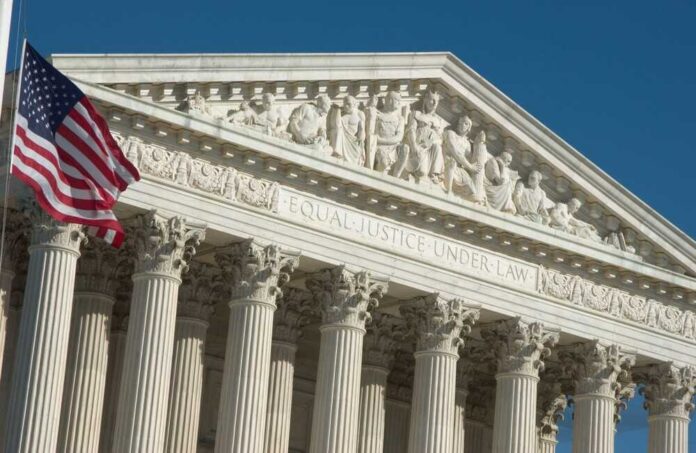
The Supreme Court just yanked power back from activist lower judges in Alabama, reminding them that unelected panels do not outrank the people’s elected lawmakers.
Story Snapshot
- The United States Supreme Court vacated a federal panel’s order blocking Alabama’s congressional map and sent the case back for a do‑over.
- The justices directed the lower court to reconsider Alabama’s map under the Court’s new limits on the Voting Rights Act announced in the Louisiana Callais decision.[1][2]
- The order pushes back against a pattern of lower courts treating state legislatures as guilty until proven innocent on claims of racial gerrymandering.[1][3]
- The ruling strengthens the presumption that elected legislatures act in good faith when drawing maps, unless real proof of discrimination is shown.[1][3][5]
Supreme Court Reins In Lower Court Overreach In Alabama
The United States Supreme Court’s emergency order in Allen v. Caster vacated the judgment of the three‑judge federal district court in Alabama and remanded the redistricting case for reconsideration.[1] The justices told the panel to apply the Court’s fresh voting‑rights guidance from the Louisiana case Callais, which narrowed how Section 2 of the Voting Rights Act can be used to attack district lines.[1][2] This move halted the panel’s attempt to keep blocking Alabama’s 2023 map in the middle of an election cycle.[2][5]
According to coverage of the ruling, Alabama had enacted a congressional map with one majority‑Black district out of seven, after years of litigation over earlier plans.[2][5] Civil rights groups claimed the map illegally diluted Black voting strength under Section 2, and the district court agreed, issuing an injunction that forced the state toward a different configuration.[2][5] Alabama officials argued that, after Callais, the panel’s approach to race‑based claims and remedies ignored the Supreme Court’s updated standards and wrongly displaced the legislature’s role.[1][3]
What “Inferior Court Supremacy” Means For Election Law
Legal commentary described the episode as the Supreme Court reversing a trend of “inferior court supremacy,” where lower federal judges effectively dictated election rules by aggressive injunctions that stood unless the justices stepped in.[3] In earlier cycles, district and circuit courts used broad readings of the Voting Rights Act to order new maps on tight election timelines, betting that the Supreme Court would not intervene late.[2][5] The Alabama order signaled that, after Callais, those tactics will get closer scrutiny and cannot override the presumption that legislatures act lawfully.[1][3]
Writers noted that the Court’s action does not automatically bless every partisan‑leaning map or forbid challenges to real discrimination.[2][5] Instead, it insists that lower courts apply the same evidentiary and remedial constraints the Supreme Court laid down in Louisiana, rather than inventing new racial‑quota style baselines for seats.[1][3] For conservative readers, that means fewer opportunities for progressive litigators to use distant federal panels to redraw states from Washington, while genuine violations of equal protection and the Voting Rights Act remain addressable through properly grounded cases.[1][3][5]
Implications For Federalism, Elections, And Conservative Priorities
The Alabama ruling fits a broader pattern where the Supreme Court has reminded federal courts that they are not free‑floating super‑legislatures, particularly in redistricting fights.[1][3] By vacating the injunction and returning the case, the justices reinforced core federalism principles: state governments set the rules unless they clearly violate the Constitution or federal law.[1][5] That framework respects the voters who chose their legislatures, instead of empowering distant judges to impose maps that conveniently aid one national party’s strategy.[3][5]
U.S. SUPREME COURT ALLOWS ALABAMA TO USE CONTROVERSIAL CONGRESSIONAL MAP FOR THIS YEAR’S ELECTIONS
The United States Supreme Court has ruled that Alabama can continue using its current congressional district map for this year’s elections. The decision temporarily blocks a lower… pic.twitter.com/KoQACjCDPI
— Global World TV News (@GlobalC83910) June 3, 2026
For conservatives worried about election integrity and creeping judicial activism, this decision is a concrete example of the judiciary beginning to correct its own excesses.[1][3] The order also matters beyond Alabama, because many other states face copy‑paste lawsuits using the same theories that the Callais decision pared back.[2][5] Going forward, activists will have a harder time claiming discrimination anytime a map does not guarantee a preferred racial or partisan outcome, and legislatures will have a stronger hand to defend traditional districting choices.[1][3][5]
Sources:
[1] Web – The Supreme Court Reverses Inferior Court Supremacy In Alabama
[2] Web – [PDF] 25-243 Allen v. Caster (05/11/2026) – Supreme Court
[3] Web – Republican-Appointed Judges Just Gave the Roberts Court a …
[5] Web – Bailey v. Alabama | 219 U.S. 219 (1911) – Justia Supreme Court