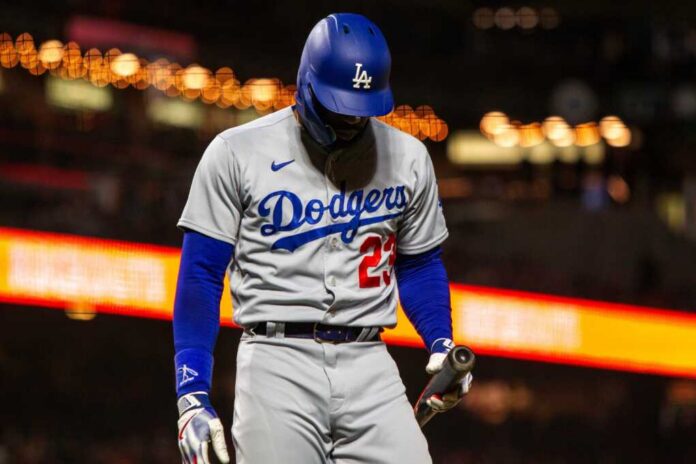
MLB’ looming 2026 labor fight just got hotter as star players openly cheer the Dodgers’ $400 million payroll—daring critics to keep up instead of begging for a salary cap.
Quick Take
- The Los Angeles Dodgers are entering 2026 with a projected payroll around $400 million after adding major contracts, drawing fresh backlash from fans worried about competitive balance.
- Rival stars Manny Machado and Bryce Harper praised the Dodgers’ spending, arguing it lifts player value and reflects smart team-building—not “ruining baseball.”
- MLB’s current system has no hard salary cap, and the collective bargaining agreement is set to expire Dec. 1, 2026, putting payroll inequality at the center of upcoming talks.
- Big-market spending is colliding with small-market frustration, setting up a high-stakes debate over parity, caps, and the league’s long-term stability.
Dodgers’ $400M roster becomes the flashpoint heading into 2026
The Dodgers’ projected payroll near $400 million has become the defining storyline of early 2026 spring training, not only because of the dollars but because it spotlights how MLB is structured. Los Angeles is coming off a 2025 World Series title and has continued to add elite talent, including outfielder Kyle Tucker on a four-year, $240 million deal and closer Edwin Díaz on a three-year, $69 million deal.
Dodgers leadership has publicly signaled that the organization’s priority is winning championships rather than appeasing critics. That stance matters because it’s not just a baseball argument anymore; it’s a business and labor argument. In a league without a hard salary cap, the teams with the most revenue and the most aggressive ownership can push the market upward, forcing everyone else to respond through development, trades, or risk tolerance.
Machado and Harper reject the “ruining baseball” narrative
San Diego Padres star Manny Machado delivered the quote that captured the moment: he said he loves what the Dodgers are doing and argued that every team should be willing to spend. The remark landed hard because Machado plays for a division rival and because the Padres themselves previously spent at the top of the market before scaling back. His comments also reinforce a long-standing player preference: resist any move toward a cap.
Philadelphia Phillies star Bryce Harper echoed that basic view while framing the Dodgers as an example of running a team “like a business the right way.” Harper also pointed out a reality fans sometimes ignore: teams have multiple ways to build winners, including drafting, developing, and trading well. The players’ argument is simple and consistent with their interests—high-end spending can raise the market for everyone, while caps typically restrain it.
Why the payroll debate is really about the 2026 CBA deadline
The current collective bargaining agreement is set to expire on Dec. 1, 2026, and that deadline is why these February comments matter. A $400 million payroll doesn’t just create headlines; it creates negotiating leverage and pressure. Owners and small-market executives can point to widening payroll gaps as evidence that “something must be done,” while the MLB Players Association can point to a free market that rewards talent.
ESPN’s reporting has framed the Dodgers’ dominance as making a salary cap a “hot topic,” and that is the core tension: competitive parity versus labor freedom. For conservatives who value fair rules and transparent competition, the key question is what reforms would actually improve outcomes without simply handing more power to league offices and billionaire owners. The research here doesn’t provide a detailed reform menu, but it does show the battle lines clearly forming.
Small-market frustration grows, but the facts show uneven options
Fan anger often centers on competitive balance, and that frustration is understandable when one franchise can tower over the field financially. Reported payroll figures put the Mets around $368 million and the Yankees around $333 million, with the Phillies around $311 million and the Padres around $258 million—still huge numbers, but trailing Los Angeles. The gap fuels claims that outcomes are being “bought,” even when spending alone can’t guarantee titles.
The reality is that telling every club to “just spend” is not the same as proving every club can spend. Machado’s claim reflects a player’s perspective, not a full accounting of local TV deals, ownership appetite, stadium revenue, or debt. That said, Harper’s counterpoint is also real: smart drafting and player development can narrow gaps. The research doesn’t quantify which approach wins most often, so the strongest conclusion is that MLB’s incentives push teams into different strategies.
What to watch next as baseball’s power imbalance meets politics of control
The immediate baseball consequence is straightforward: the Dodgers enter 2026 as favorites to chase another title with a roster built to overwhelm opponents late in games and across a long season. The bigger consequence is what happens when the league tries to “fix” the gap. A hard cap would be a major structural intervention—more centralized control, more restrictions, and fewer open-market outcomes for players.
At the same time, doing nothing means the sport keeps testing the patience of fans who want a level playing field. That tension is exactly what makes the 2026 CBA fight so important. The two cited reports establish the core facts—Dodgers spending, rival-star praise, and a looming expiration date—while leaving open the hardest question: whether MLB can improve parity without triggering a shutdown that punishes working families who just want to watch the game.
Sources:
MLB All-Stars react to Dodgers’ massive $400 million payroll for 2026 season: ‘I f—ing love it’
Padres’ Manny Machado says Dodgers spending ‘great for the game’
Dodgers Payroll (RosterResource)