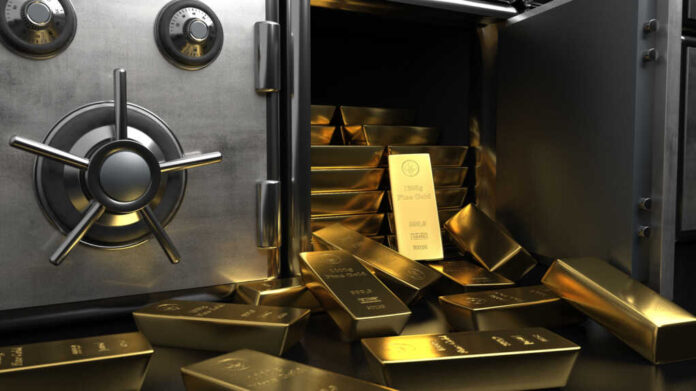
Gold has made a historic move, surging past $5,000 per ounce and reaching $5,058, its steepest annual climb since 1979. This dramatic rally reflects a massive investor flight from government bonds, driven by deep concerns over political instability, ongoing threats to Federal Reserve independence, and global market disruption caused by reckless Washington policies. Major banks are now forecasting further gains, with some projecting a $6,000 peak by spring 2026.
Story Snapshot
- Gold hit $5,058 per ounce on January 25, 2026, marking a 15% gain year-to-date and capping a 65% surge in 2025—the steepest annual climb since 1979
- The rally reflects investor flight from government bonds amid concerns over the Trump administration’s tariff threats, Fed interference, and military actions destabilizing global markets
- Major banks predict further gains, with Goldman Sachs forecasting $5,400 and Bank of America projecting $6,000 by spring 2026
- Silver paralleled the surge, topping $100 per ounce and climbing to $107.80, driven by safe-haven demand and critical minerals designation
Historic Milestone Reflects Bond Market Warning
Gold prices shattered the $5,000 barrier late Sunday evening, reaching $5,058 per troy ounce in electronic trading as investors sought refuge from volatile government policies. The precious metal posted a 1.4% gain on the day and an 8.4% weekly surge, following Friday’s record settlement at $4,979.70. Silver mirrored the rally, jumping 4.5% to $107.80 per ounce after breaching the symbolic $100 mark earlier in the week. This flight to hard assets underscores eroding confidence in fiat currencies and sovereign debt, a troubling sign for taxpayers stuck holding the bag on Washington’s reckless spending.
Gold tops $5,000 in a warning for government bonds: Government bond markets in high-debt countries are under pressure as investors fear heavy borrowing will erode the value of money. https://t.co/QaWygjHj3a pic.twitter.com/jKt6LEcZQW
— Tali9119 (@tali9119) January 26, 2026
Trump Policies Fuel Safe-Haven Exodus
President Trump’s post-inauguration actions have sparked unprecedented market turbulence, driving the precious metals boom. His administration’s tariff threats against Canada, revoked Greenland annexation levies, military capture of Venezuelan President Nicolás Maduro, and criminal investigation into Federal Reserve Chair Jerome Powell created a whipsaw effect investors call “policy whiplash.” The “Liberation Day” tariffs launched April 2, 2025, and June’s “One Big Beautiful Bill Act” revenge tax accelerated gold’s ascent, pushing prices to double within 12 months. Trump’s Saturday warning of 100% tariffs on Canada if it pursued a China deal—denied by Ottawa—further rattled markets ahead of Sunday’s breakthrough.
BREAKING: Gold reaches $5,000 for the first time in history pic.twitter.com/4siIIyIcFH
— Watcher.Guru (@WatcherGuru) January 25, 2026
Fed Independence Under Fire
The administration’s probe into Fed Chair Jerome Powell represents a direct assault on central bank autonomy, a cornerstone of free-market stability conservatives have long defended. Trump’s August 2025 threats to fire Fed Governor Lisa Cook and ongoing attacks on monetary policy independence have spooked investors who rely on the Fed’s apolitical stance to anchor dollar credibility. Combined with persistent inflation, a weakening dollar, and expected rate cuts, these moves undermine the very institutions that should protect Americans’ purchasing power. Global central banks responded by ramping up gold purchases, further fueling demand as they hedge against dollar instability and Washington’s fiscal mismanagement.
Banks Forecast Further Gains Amid Stretched Valuations
Goldman Sachs analysts project gold will reach $5,400 per ounce, citing policy uncertainty as the primary driver, while Bank of America’s Michael Hartnett forecasts a $6,000 peak by spring 2026. SPI Asset Management’s Stephen Innes noted the “fiscal story” of mounting deficits and policy tests persists beyond headline volatility, creating sustained demand for stability. However, technical indicators flash caution: gold now trades over 100% above its 200-day moving average, suggesting stretched valuations that could snap back if euphoria fades. Money Metals’ Stefan Gleason highlighted silver’s catch-up potential after the gold-to-silver ratio spiked to 106 post-tariffs, while BullionVault’s Ash attributed the rally partly to the revenge tax spooking bond investors.
The metals surge carries profound implications for ordinary Americans. Short-term, investors are dumping government bonds and stocks for precious metals, signaling instability that erodes retirement portfolios and savings. Long-term, if policy volatility persists, gold’s climb to $6,000 or beyond could cement distrust in US Treasuries, raising borrowing costs and compounding the national debt crisis. Exporters in Canada and Europe face tariff risks that threaten jobs, while retirees and dollar holders watch inflation eat purchasing power. This isn’t just a market story—it’s a referendum on Washington’s abandonment of fiscal discipline and constitutional limits, leaving hardworking families to bear the cost of globalist overreach and currency debasement.
Watch the report: SHOCKING: $5,000 GOLD Spike! Is the US DOLLAR Collapsing Under Trump?
Sources:
Gold tops $5,000 as concerns over Trump upending global relations drive historic rally
Gold now costs more than $5,000 an ounce. Here’s how it got to this milestone price
Forget $5,000 — Bank of America sees gold price hitting $6,000/oz by spring 2026
Gold surges past $5,000 to a fresh record