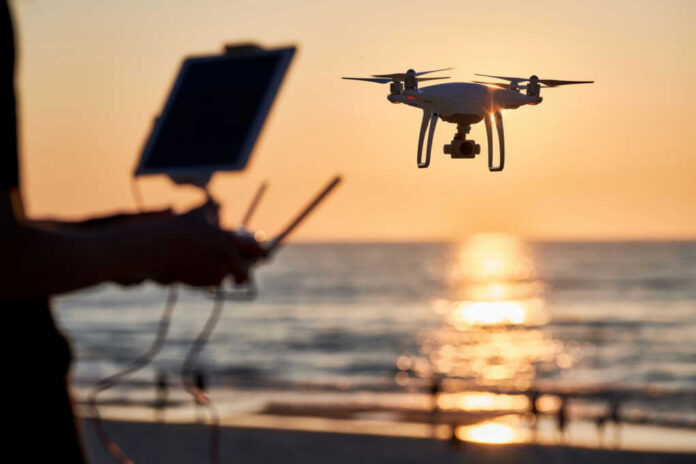
French prosecutors say a Belarus-born man spied on a drone maker for Russia—yet the public still has not seen the proof behind the charge.
Story Snapshot
- Paris prosecutors announced suspected spying tied to Russian interests [1][2][3]
- Allegations include making contacts with a foreign power and collecting information [1]
- Case highlights Europe’s wider spy scares and hidden evidence trend [1][2]
- Defense claims and specific proof remain unclear in public reports
Prosecutors Outline Espionage Allegations Involving Drone Technology
Paris prosecutors said a Belarus-born man in France gathered intelligence for Russia focused on a drone manufacturer, part of a broader probe into suspected pro-Russia activity [1][2][3]. Officials described preliminary allegations of conspiracy, establishing intelligence contacts with a foreign power, and collecting information for that power, crimes that can bring long prison terms and heavy fines if proven [1]. Reports tie the inquiry to pro-Russia propaganda and possible economic intelligence targeting French firms [1][2]. Authorities have not released charge sheets to the public.
Media accounts say four people were swept up in related actions, including a woman who leads a France-based group linked to Donbas and a man filmed placing pro-Moscow posters at the Arc de Triomphe [1][2][3]. Prosecutors and France’s domestic security service opened a judicial investigation earlier in the year, citing actions that could hurt national interests [2]. The Belarus-born suspect’s exact role, methods, and reported targets inside the drone sector are not detailed in public summaries. Officials have not displayed seized devices or money trails.
Evidence Gaps Keep the Case Behind a Curtain
The public reporting follows a pattern seen across Europe: governments announce espionage allegations first, while specific proof stays sealed for months or even longer [1][2]. Prosecutors use legal phrases that sound technical, such as “intelligence contacts with a foreign power,” but those terms describe charges, not courtroom-tested evidence [1]. That caution matters. The press has not shown surveillance logs, message intercepts, or forensic reports that would confirm the Belarus-born man acted under Russian tasking. Defense responses have also been scarce in open sources.
Reuters, Al Jazeera, and NBC News align on the core point that French authorities suspect a Russia-linked effort in France, with preliminary charges and multiple detentions [1][2][3]. They differ in detail level and emphasis. NBC News cites the charge wording and penalty range [1]. Al Jazeera stresses propaganda angles and prior monitoring by security services [2]. Reuters confirms the arrests and the foreign-power allegation but adds few specifics [3]. None supply a public document naming the Belarus-born man with a full timeline and the drone firm’s identity.
Why This Matters for America’s Security and Industry
Russia and Belarus have chased Western technology, logistics data, and influence for years, and European services have disrupted spy rings tied to those regimes [6][20]. Drones are central to modern war and border security. If Moscow can map French suppliers or tactics, that knowledge can ripple across the North Atlantic Treaty Organization (NATO) lines and threaten allies. America depends on allied supply chains and base access. Any breach in Europe can expose U.S. know-how, soldiers, and contractors working with partners.
Conservatives should track two risks at once. First, espionage is real, and hostile services target our tech, energy, and industry. Tough counterintelligence protects jobs, troops, and our edge. Second, broad claims without visible proof can be misused by elites to chill speech, label dissent, or hide policy blunders. The right path is firm law enforcement paired with due process and transparency. Ask for verifiable facts, timely court testing, and clear lines that punish spies without smearing lawful advocacy.
What to Watch Next
Watch for filings that name the Belarus-born suspect, list seized items, and show contacts, payments, or tasking. Look for court rulings that test whether “contacts with a foreign power” meant actual spying or only political messaging. Track whether French officials identify the drone company and any harm. Compare this case with other recent European disruptions, where agencies documented meetings, money, and classified leaks tied to Belarus and Russian networks [20]. Real cases produce paper trails, devices, and witnesses.
Bottom Line for Readers
France says a Belarus-born man spied on a drone maker for Russia, and that is a serious charge in a dangerous time. The claim fits a broader pattern of Kremlin-linked operations in Europe. But the public has not seen the evidence yet. Demand both strong security and honest process. America is safer when our allies catch real spies and when courts separate facts from slogans. That balance guards our liberty, industry, and the rule of law we want at home.
Sources:
[1] Web – France detains man on charges of spying on drone factory for Russia: …
[2] Web – Russian nationals among 4 people arrested in France over …
[3] Web – France detains four amid inquiry into suspected Russian spy network
[6] Web – French authorities arrest three people suspected of spying for …
[20] Web – Belarusian spy ring dismantled – Mishcon de Reya