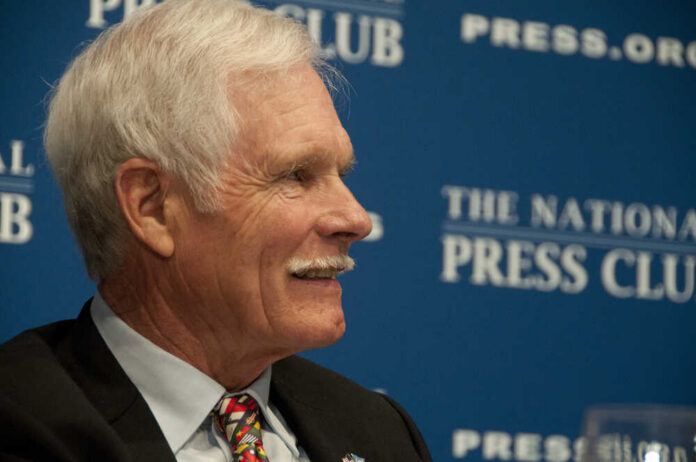
Ted Turner’s death exposes the deep flaws in the 24-hour news cycle he created, now dominated by biased elites pushing agendas over truth.
Story Highlights
- Ted Turner, CNN founder, dies at 87 on May 6, 2026, at his Florida home after battling Lewy body dementia.
- Turner pioneered CNN in 1980, launching the endless news cycle that conservatives see as fueling division and misinformation.
- His media empire, sold to Time Warner, shaped cable TV but raised concerns about corporate control and sensationalism.
- CNN’s Mark Thompson hails Turner as a “giant,” amid questions about the network’s future identity and bias.
- Legacy includes philanthropy like the UN Foundation, but critics link his innovations to declining journalistic standards.
Turner’s Pioneering Role in Media
Ted Turner died on May 6, 2026, at age 87 in his home near Tallahassee, Florida. Family spokesman and Turner Enterprises confirmed the passing. Born November 19, 1938, in Cincinnati, Ohio, Turner took over the family business in 1970, renaming it Turner Communications Group. He launched WTBS in 1976, pioneering the superstation via satellite. In 1980, Turner founded CNN, the world’s first 24-hour cable news network, revolutionizing information access.
Building a Vast Media Empire
Turner expanded aggressively, creating TNT in 1988 and Cartoon Network in the 1990s, plus Turner Classic Movies. He owned the Atlanta Braves from 1976 to 2007, winning the 1995 World Series. His empire merged with Time Warner, shifting him toward philanthropy, including founding the United Nations Foundation. Health declined after his 2018 Lewy body dementia diagnosis and 2025 pneumonia hospitalization. Turner stepped back from operations, leaving CNN under leaders like Mark Thompson.
CNN Leadership Responds to Loss
Mark Thompson, CNN Worldwide Chairman and CEO, stated: “Ted was an intensely involved and committed leader, intrepid, fearless and always willing to back a hunch and trust his own judgement. He was and always will be the presiding spirit of CNN.” Major networks like CNN, Fox News, CBS News, and ESPN aired breaking coverage. Tributes emphasize Turner’s risk-taking, yet his 24-hour model accelerated news but invited sensationalism over depth, eroding trust across political lines.
Conservatives long criticized CNN’s left-leaning bias under Turner’s legacy, part of a media landscape where outlets cater to ideologies. Both sides now share frustration with elite-controlled news failing everyday Americans, prioritizing reelection and power over truth and the American Dream.
Legacy and Broader Impacts
Turner’s death prompts reflection on media’s evolution. His innovations democratized news but fueled nonstop cycles criticized for reducing verification and promoting division. CNN faces identity questions without its founder, while Turner Enterprises manages a billion-dollar estate. Philanthropic efforts continue via the UN Foundation. The industry confronts founder-dependent structures, as Americans from left and right decry deep state influences corrupting information flow and traditional values.
Short-term, retrospectives dominate coverage, assessing cable TV’s shift. Long-term, Turner’s story warns of corporate media consolidation undermining individual liberty and honest discourse. In Trump’s second term, with GOP control, his passing underscores calls for media accountability amid government failures serving elites over citizens.
Sources:
ESPN: Ted Turner, former Braves owner and media mogul, dies at 87
Broadband TV News: CNN founder Ted Turner dies aged 87