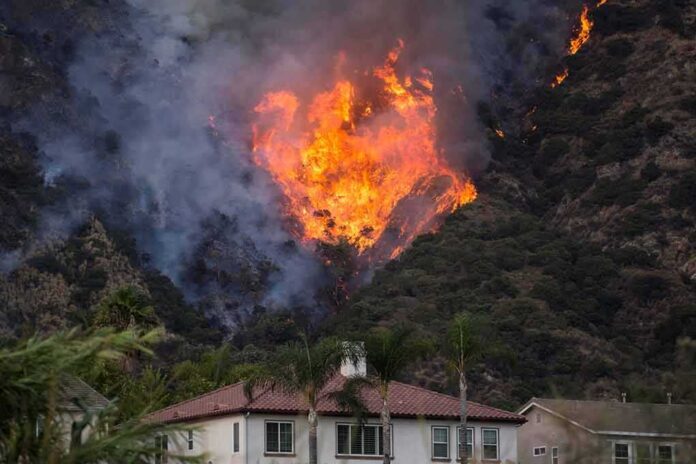
A new 724-page investigation into the deadly Palisades fire found that Los Angeles firefighters went home despite dangerous winds, and some residents got no warning until their homes were already on fire.
Story Snapshot
- An independent report found evacuation alerts reached some residents 40 to 90 minutes after flames hit their homes.
- Investigators say the Los Angeles Fire Department ignored warnings that an earlier fire was still smoldering before it reignited into the Palisades fire.
- Fire and police departments struggled to track personnel and share information during the disaster.
- The report blames no single person or agency, pointing instead to broken systems across the board.
- Fire officials defend their choices, citing limited resources and the need to cover the whole city.
Report Exposes Delayed Warnings And Ignored Risks
The California-commissioned investigation, carried out by UL Research Institutes’ Fire Safety Research Institute, says firefighters were released from duty even as forecasters warned of dangerous winds. Some residents did not get evacuation alerts until 40 to 90 minutes after fire had already reached their neighborhoods. A helicopter crew warned at 10:46 a.m. that flames would hit homes “within minutes,” but a full evacuation order did not go out until 11:29 a.m.
Investigators also found that the Los Angeles Fire Department ignored repeated warnings that a fire from New Year’s Day was still smoldering, days before it exploded into the Palisades fire. The report says the department had no clear process to make sure such fires were fully put out, a gap that let a seemingly small problem grow into a deadly blaze.
Agencies Struggled To Communicate Under Pressure
The Los Angeles Fire Department had trouble tracking its own personnel during the fire and did not coordinate well with Los Angeles police officers who were helping evacuate residents. Responders could not reliably share information because of weak cell signals, inconsistent updates from the field, and communication systems that did not connect to one another. These breakdowns slowed decisions exactly when speed mattered most.
The report also found the alert system itself was too complicated. Multiple agencies shared overlapping authority, and some personnel were not familiar with the warning tools they were supposed to use. That confusion, investigators say, helped create the gap between when danger was known and when the public actually found out.
Fire Officials Defend Their Decisions
Los Angeles Fire Chief Kristin Crowley has defended her department, saying commanders had to be strategic with limited resources while still handling normal 911 calls. Deputy Chief Richard Fields called the staffing decisions “suitable for immediate response” and said they reflected years of experience balancing citywide needs. City officials say the Emergency Operations Center was already active and that crews had been pre-deployed overnight before the fire broke out.
The city also says a formal evacuation order reached nearby mobile phones by 12:30 p.m. through the wireless alert system, and that an incident command post uniting fire and police units was set up by around noon. These accounts show agencies describing a coordinated response, even as the new investigation documents major gaps in that same response.
No Single Agency Takes The Blame
Despite detailing specific failures, the report stops short of blaming one person or agency for the disaster. Investigators frame it as a systems failure, where outdated policies, unclear procedures, and overlapping responsibilities combined with extreme winds to create conditions no single fix could have prevented. That framing matters because it keeps the focus on fixing structures, not just assigning blame.
The report calls for clearer evacuation priorities, stronger coordination between agencies, and standard procedures for checking fires after they appear to be out. For families who lost homes or loved ones, the findings confirm what many feared: warning systems meant to protect them did not work fast enough, and the agencies in charge are only now facing full public scrutiny over why.
The full report, along with its appendices and interview records, has not been fully released to the public, so some details remain filtered through summaries rather than original documents. Still, the core findings on delayed alerts, ignored warnings, and failed coordination are drawing bipartisan concern from residents who say government agencies, regardless of who runs them, failed at the most basic job: keeping people safe and informed.
Sources:
facebook.com, nypost.com, westsidecurrent.com, apnews.com, iheart.com, us.headtopics.com, malibucity.org, emergency.lacity.gov