
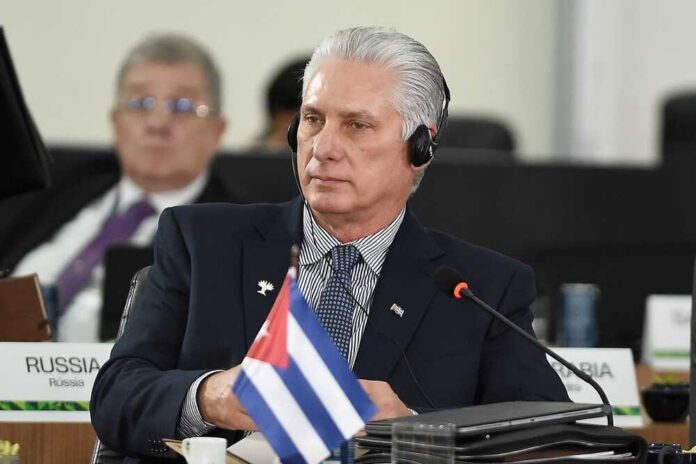
The Trump administration has directly sanctioned Cuba’s sitting president, a move that escalates decades of U.S. pressure on the island’s communist leadership while drawing fierce condemnation from Havana.
Story Highlights
- The U.S. Treasury Department formally sanctioned Cuban President Miguel Díaz-Canel along with four other Cuban government officials.
- The action represents a deliberate leadership-pressure strategy, targeting named individuals rather than applying broad economic measures alone.
- Díaz-Canel fired back, calling the sanctions “abusive collective punishment” and claiming no Cuban official holds assets under U.S. jurisdiction.
- The move fits a long pattern of U.S. sanctions escalations against Cuba, with both sides trading familiar accusations about accountability versus collective harm.
Treasury Targets Cuba’s Top Leader
The United States Treasury Department formally sanctioned Cuban President Miguel Díaz-Canel, according to a filing posted on the Treasury’s official website. [1] Four additional Cuban officials were included in the same action, extending the pressure campaign beyond the presidency to other key figures in the island’s government. [3] The sanctions freeze any assets the named individuals hold under U.S. jurisdiction and generally prohibit Americans from conducting financial transactions with them.
This latest round of sanctions is part of a broader Trump administration effort to squeeze Cuba’s ruling class directly rather than relying solely on broader trade restrictions. [4] By naming Díaz-Canel personally, Washington signals that it holds the president individually accountable for the Cuban government’s human rights record and its continued authoritarian governance. The Treasury filing makes the action legally binding and operationally specific, giving it more weight than a diplomatic statement alone. [1]
Havana Pushes Back Hard
Díaz-Canel wasted no time rejecting the sanctions, publicly calling them abusive collective punishment and insisting that no member of the Cuban government or military holds assets or property protected under U.S. legal jurisdiction. [5] That argument cuts to the heart of a recurring debate: if targeted officials have no U.S.-based assets to freeze, critics question how much practical coercive leverage the sanctions actually generate beyond a symbolic condemnation. Díaz-Canel also used a United Nations General Assembly appearance to criticize what he called U.S. “coercive” measures against the island. [6]
Cuba’s government went further, with state media and officials accusing Washington of waging economic warfare amounting to genocide against the Cuban people. [2] That framing is a standard element of Havana’s diplomatic playbook, designed to rally international sympathy and frame U.S. pressure as targeting ordinary Cubans rather than the leadership. Whether that argument gains traction internationally depends largely on how the sanctions are perceived to affect daily life on the island versus the officials named in the Treasury filing.
A Decades-Long Standoff Escalates Again
U.S. sanctions on Cuba are not a new invention — they form part of an entrenched policy architecture dating back more than six decades, with periodic escalations tied to changes in U.S. administrations and events on the island. [3] What distinguishes this round is the direct personal targeting of a sitting Cuban head of state, a step that raises the diplomatic stakes and signals the Trump administration’s willingness to apply maximum pressure on Cuba’s leadership structure rather than pursue engagement.
Trump administration imposes sanctions on Cuban President Miguel D az-Canel in latest move to pressure leadership, reports AP. pic.twitter.com/TsYfd00CuW
— Press Trust of India (@PTI_News) June 5, 2026
For Americans watching this unfold, the debate mirrors a frustration familiar across the political spectrum: do these sanctions actually change anything, or do they give Washington a way to look tough while Cuba’s government stays firmly in place and ordinary Cubans absorb the economic pain? The Trump administration’s position is that holding named leaders personally accountable is the right and necessary approach. Díaz-Canel’s counter is that the move is both toothless and cruel. History suggests both sides will keep making those same arguments for years to come, while Cubans on the island and in the United States watch and wait for something to actually change.
Sources:
[1] Web – U.S. sanctions Cuban president as Trump administration puts pressure …
[2] Web – U.S. sanctions Cuban President Miguel Díaz-Canel in … – CBS News
[3] YouTube – New sanctions on Cuba’s leaders prompts strong reaction from …
[4] Web – US sanctions Cuban President Miguel Díaz-Canel in latest move to …
[5] Web – US sanctions Cuban President Miguel Díaz-Canel in latest move …
[6] YouTube – Cuba president condemns additional sanctions imposed by Trump …