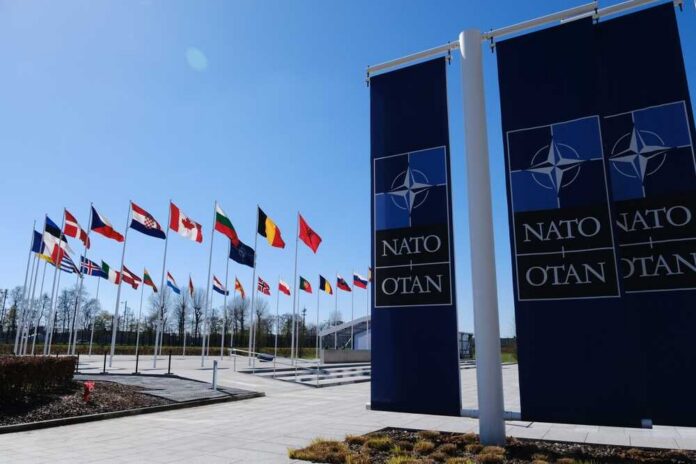
NATO Secretary General Mark Rutte walked a diplomatic tightrope at the White House after President Trump publicly branded the alliance “cowards” for refusing to back his military operations against Iran, exposing deep fractures in the 75-year-old partnership.
Story Snapshot
- Trump slammed NATO allies as “cowards” and a “paper tiger” for declining to join Iran operations or provide naval support for the Strait of Hormuz
- Rutte met with Trump and Secretary of State Marco Rubio at the White House, diplomatically defending NATO’s position without directly criticizing the President
- NATO emphasized its longstanding stance that Iran cannot possess nuclear weapons or advanced missiles, noting the alliance intercepted Iranian ballistic missiles targeting Turkey on three occasions
- The clash highlights fundamental tensions between Trump’s unilateral military action and NATO’s collective decision-making process, raising questions about the alliance’s future relevance
Trump’s Frustration With NATO Boils Over
President Trump unleashed scathing criticism of NATO allies during public remarks, labeling them “cowards” for refusing to participate in military operations against Iran. Trump requested that NATO members provide naval forces to help secure the strategically vital Strait of Hormuz, but allies uniformly declined. The President went further, accusing NATO of actively obstructing American efforts by denying access to landing strips and other military support infrastructure. Trump stated the alliance “never helped us,” expressing deep frustration with what he perceives as European freeloading on American military might while refusing to support U.S. operations when called upon.
Rutte’s Calculated Diplomatic Response
NATO Secretary General Mark Rutte traveled to the White House days after Trump’s public condemnation to meet with the President and Secretary of State Marco Rubio. During a news conference presenting NATO’s 2025 annual report, Rutte carefully avoided directly responding to Trump’s “organization of cowards” characterization, instead stating “the alliance is very dear to me.” Rutte defended NATO’s position by emphasizing the alliance’s consistent historical stance that Iran cannot possess nuclear weapons or advanced missile capabilities. He highlighted NATO’s operational success in intercepting Iranian ballistic missiles heading toward Turkey on three separate occasions, demonstrating the alliance does take action against Iranian threats within its collective framework.
The Deeper Issue: Collective vs. Unilateral Action
The confrontation reveals fundamental tensions about NATO’s decision-making authority and operational relevance in an era where the United States increasingly acts unilaterally. Trump initiated military operations to degrade Iran’s capabilities without formal NATO coordination or approval, then criticized allies for not joining an operation they never agreed to support. This sequence exposes a core question: does NATO exist to rubber-stamp American military decisions, or does it maintain independent collective decision-making authority? For Americans frustrated with globalist institutions that constrain U.S. sovereignty, Trump’s willingness to bypass NATO altogether resonates. Yet for those concerned about strategic overreach, the lack of allied support suggests legitimate questions about the wisdom of unilateral military escalation.
The situation grew more complicated when some NATO allies deployed forces to Greenland, apparently positioning against Trump’s stated territorial ambitions rather than supporting American operations against Iran. Secretary of State and Defense officials skipped certain NATO meetings, further signaling American frustration with the alliance. These developments suggest NATO faces an existential crisis about its purpose and cohesion. If the alliance won’t support the United States in operations against a longtime adversary like Iran, what purpose does it serve beyond providing a forum for European countries to lecture Americans about defense spending while contributing minimal military capability?
What This Means for Alliance Unity
Rutte’s diplomatic balancing act cannot obscure the underlying reality: NATO appears increasingly unable to function as a unified military alliance when actual operations are required. The organization maintains theoretical positions about Iran’s nuclear ambitions but declines to support concrete military action to enforce those positions. For ordinary Americans bearing the tax burden of defending Europe for decades, this looks like the classic problem of allies that demand American protection while criticizing American leadership. The tension between Trump’s America First approach and NATO’s collective decision-making represents more than bureaucratic disagreement—it reflects fundamentally different visions of how international security should function in the 21st century.
The long-term implications extend beyond Iran policy to NATO’s viability as an institution. If unilateral American action becomes normalized because collective NATO decision-making proves too cumbersome or risk-averse, the alliance’s relevance will continue eroding. Conversely, if Trump’s frustrations lead to further U.S. disengagement from NATO, European allies face the uncomfortable reality of providing their own defense without American military backing. Rutte’s careful diplomacy buys time, but it cannot resolve the fundamental question both conservatives and progressives increasingly ask: does this expensive Cold War relic serve American interests, or does it primarily benefit European governments that refuse to spend adequately on their own defense?
Sources:
CBS News: Mark Rutte White House Visit After Trump’s NATO Criticism