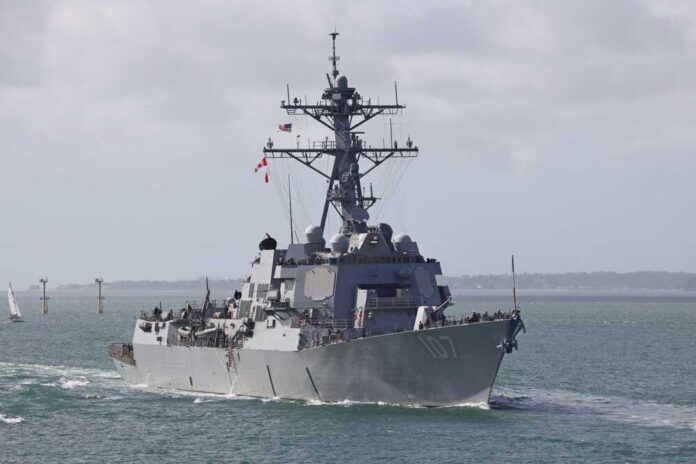
The U.S. Navy is testing armed, autonomous surface vessels capable of operating without a single sailor on board — and the senator who chairs the Armed Services Committee says America isn’t moving nearly fast enough to field them at scale.
Story Snapshot
- The Navy is developing and testing armed Uncrewed Surface Vessels, known as TSUNAMI, designed to operate autonomously in contested waters.
- Senate Armed Services Committee Chairman Roger Wicker argues the U.S. defense budget falls dangerously short of what’s needed to field unmanned platforms and other near-term capabilities at scale.
- Wicker has proposed $55 billion in additional defense spending and introduced the SHIPYARD Act authorizing $25 billion for shipbuilding investment.
- The core debate mirrors a decades-old Washington pattern: whether new military technology should be funded as immediate force structure or allowed to mature slowly through experimentation accounts.
Armed and Unmanned: What the Navy Is Testing
The Navy’s Tactical Autonomous Systems program is developing and testing the TSUNAMI — Tactical Strike Unmanned Autonomous Maritime Integrated — class of uncrewed surface vessels. These armed, self-navigating boats are designed to operate in contested maritime environments without crew aboard, extending the Navy’s reach while reducing risk to sailors. The vessels represent a new category of warfighting capability that defense planners argue could be decisive in a potential Pacific conflict, particularly against China’s rapidly expanding naval forces.
The strategic logic behind unmanned surface vessels is straightforward: they can be produced faster and more cheaply than traditional warships, deployed in large numbers, and used for surveillance, mine-laying, or direct strike missions. In a potential Taiwan Strait scenario, swarms of such vessels could complicate enemy targeting and extend American reach across vast ocean distances. The question dividing Congress and the Pentagon is not whether these systems are valuable — both sides agree they are — but how quickly and at what funding level the transition from prototype to operational fleet should happen.
Wicker’s Warning: Investment Is Falling Short
Senator Roger Wicker of Mississippi, chairman of the Senate Armed Services Committee, has been the most prominent voice arguing the current pace is dangerously inadequate. In a Senate floor speech, Wicker stated the U.S. needs to make a “monumental investment in maritime infrastructure” and called for moving ahead immediately with “purchases of sea mines, unmanned platforms, and long-range munitions” as near-term priorities. [4] His argument is that America’s adversaries are not waiting for Washington’s budget cycles to catch up with strategic reality.
Wicker’s concerns extend well beyond unmanned vessels. His 2024 defense investment blueprint called for $55 billion in additional defense spending to put the country on what he described as a “wartime footing immediately.” [1] He has also introduced the SHIPYARD Act, which authorizes $25 billion in shipbuilding investment, arguing that American shipyards are ready to build more hulls but lack the machine tooling, workforce support, and materials funding to do so. [4] He has also pressed for block-buy procurement contracts, which he argues would save taxpayer money while sustaining production lines. [2]
The Pentagon’s Counter: Procurement Is Already Scaling
Defense Department officials have pushed back against the characterization that unmanned systems are being neglected. Senior officials have testified that the department is actively shifting small unmanned systems from experimentation toward competitive procurement, committing $1.1 billion over an 18-month window to purchase drone systems and ordering tens of thousands of small one-way attack platforms in repeating procurement cycles. [7] The argument from the Pentagon’s side is that the transition from prototype to production is underway, just not at the speed congressional hawks prefer.
This tension reflects a recurring structural conflict in defense acquisition. Congress tends to want visible, near-term procurement numbers it can point to, while the military services often prefer to let systems mature through experimentation before locking in large production contracts. Moving too fast can mean buying immature technology at scale — a costly mistake the Pentagon has made before. Moving too slowly, critics argue, means adversaries gain operational experience with similar systems while America is still running tests. Neither side is entirely wrong, which is precisely why the debate persists. [3]
What Taxpayers Should Be Watching
For citizens on both the left and the right who are skeptical that Washington spends their defense dollars wisely, this debate raises legitimate questions. The Navy’s budget architecture spreads unmanned systems funding across research and development, procurement, shipbuilding, and experimentation accounts — a fragmentation that makes it genuinely difficult for outside observers to assess whether the technology is truly underfunded or simply financed through less visible channels. Transparency in that accounting would help the public hold both the Pentagon and Congress accountable. [1]
Wicker has been a consistent advocate for rebuilding American naval power, pushing for increased submarine construction, industrial-base investment, and a fleet capable of deterring China. [2] Whether his urgency on unmanned surface vessels reflects genuine strategic necessity or reflects the broader Washington tendency to frame every budget fight in existential terms is a question voters deserve the tools to answer. The Navy is testing real hardware. The money debate in Congress is real. What remains unclear — and what the public is rarely given — is a straight accounting of whether the gap between the two is as dangerous as the most alarmed voices claim. [5]
Sources:
[1] Web – Senator Wicker Unveils Major Defense Investment Plan
[2] Web – Wicker Urges Navy Nominee to Keep Focus on China, Shipbuilding …
[3] Web – Senator Wicker: U.S. national defense strategy, military budget are …
[4] YouTube – Wicker Delivers Floor Speech on Navy, China, Deterrence
[5] Web – Support Grows for SHIPYARD Act, Wicker Says – Seapower
[7] YouTube – Roger Wicker Leads Senate Armed Services Committee Hearing On …