
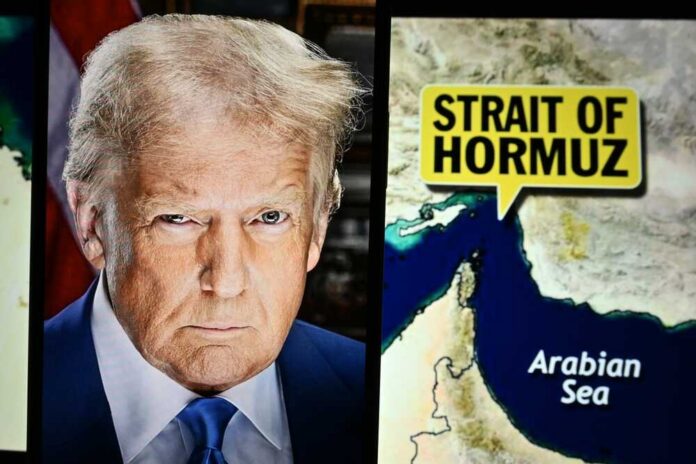
A Democrat just endorsed President Trump’s plan to “strangle” Iran’s economy by choking off the Strait of Hormuz—an escalation that could reshape Middle East deterrence and global energy prices overnight.
Quick Take
- Sen. John Fetterman (D-PA) publicly praised President Trump’s “Operation Epic Fury” and the strategy of pressuring Iran through a Strait of Hormuz blockade.
- The Strait of Hormuz is described as a chokepoint for roughly 20–30% of global oil, making any disruption economically consequential far beyond Iran.
- Republican senators also backed the operation, while Fetterman’s comments stand out as a break from typical Democratic messaging on Trump’s use of force.
- Trump is also reviewing a reported Iranian peace offer, creating a parallel track of military pressure and potential diplomacy.
Fetterman’s endorsement breaks through the usual partisan script
Sen. John Fetterman of Pennsylvania publicly applauded President Donald Trump’s Iran strategy after the launch of “Operation Epic Fury,” using unusually blunt language to describe the goal of “strangling” Iran’s economy through a blockade of the Strait of Hormuz. In statements highlighted by Fox News, Fetterman framed Trump as “willing to do what’s right and necessary to produce real peace in the region,” while also blessing the U.S. military and Israel.
For Americans used to Washington reflexively opposing whatever the other side proposes, the moment is notable less for its rhetoric than for what it signals politically: a Democratic senator aligning himself with a Trump-led hard-power approach on Iran. The recent reports did not include a full roster of Democratic responses, but it does emphasize that Fetterman’s position is viewed as a departure from the broader party’s skepticism toward aggressive pressure campaigns and pro-Israel messaging.
What “Operation Epic Fury” is aimed at—and why Hormuz matters
The operation is described as a multi-pronged effort targeting Iran’s nuclear ambitions, ballistic missile production, naval capabilities, and support for terrorism. The centerpiece drawing attention is the Strait of Hormuz pressure point—an oil transit corridor carries roughly 20–30% of global supply. Strategically, a blockade is designed to hit Iran’s revenue and logistics quickly, but it also risks immediate spillover into world energy markets.
That tradeoff sits at the heart of the debate many voters—right, left, and independent—keep revisiting: how to deter hostile regimes without handing everyday families another cost-of-living shock. The blockade approach is meant to exploit Iran’s economic vulnerability and constrain regime behavior. What remains unclear is how the blockade is being enforced day-to-day and what carveouts, if any, are being discussed to limit collateral disruption.
Bipartisan praise focuses on deterrence, not nation-building
Republican support for the operation came quickly, with senators such as Lindsey Graham and Roger Wicker praising Trump’s planning and execution and emphasizing the goal of permanently thwarting Iran’s nuclear aspirations. The research portrays the pro-operation case as “peace through strength”—using military and economic tools to reduce Iran’s capacity to threaten U.S. interests, Israel, and regional partners. Within that framing, the point is deterrence and degradation, not open-ended occupation.
From a conservative perspective it connects to a broader post-Iraq skepticism about indefinite commitments, while still treating Iran’s nuclear and terror networks as a direct national security issue. The sources supplied do not provide detailed counterarguments from critics, but the report notes political “toxicity” around supporting Trump’s actions—suggesting the loudest objections may be more partisan than operational, at least in the immediate aftermath described.
The biggest near-term risk: energy volatility and economic blowback
The Strait of Hormuz angle is where foreign policy meets the kitchen table. If the chokepoint handles a major share of the world’s oil, any disruption can translate into higher prices, raising transportation and consumer costs and complicating inflation control. The research highlights that ordinary Iranians could also face intensified hardship as Iran’s economy is squeezed. That humanitarian impact can become a propaganda tool for the regime and a pressure point in international forums.
Sen. John Fetterman praises President Trump's strategy of "strangling" Iran's economy by blocking the Strait of Hormuz. pic.twitter.com/laraZPhlMB
— Fox News (@FoxNews) May 3, 2026
At the same time, Trump is reviewing an Iranian peace offer, which introduces a second track: negotiations under maximum pressure. Whether that becomes a genuine off-ramp or simply a tactical pause is not established in the provided material. What is established is the political significance at home: a rare moment of cross-party reinforcement for a hardline approach, amid widespread public frustration that Washington often seems designed for gridlock rather than results.
Sources:
Fetterman praises ‘Operation Epic Fury,’ Trump ‘willing’ to do what’s right
Fox News video: Coverage of Fetterman praising Trump’s Iran strategy